Audience research
Part of Ethical audience research for studio equipment, from disprovable belief to consent
Studio equipment buyer personas with an evidence card, not a character sketch
Build evidence-linked equipment buyer personas for England without fictional names, invented motives or false claims about the wider creator market.
A useful studio-equipment persona is a compact evidence record for a decision. It is not a fictional biography. Label the record by function, such as 'sole operator replacing a failed audio interface' or 'college technician adding 15 MIDI controllers'. Do not invent a name, portrait or quotation that implies a real interview.
What to take away
- A studio-equipment persona is an evidence record for a decision, not a fictional biography with invented names.
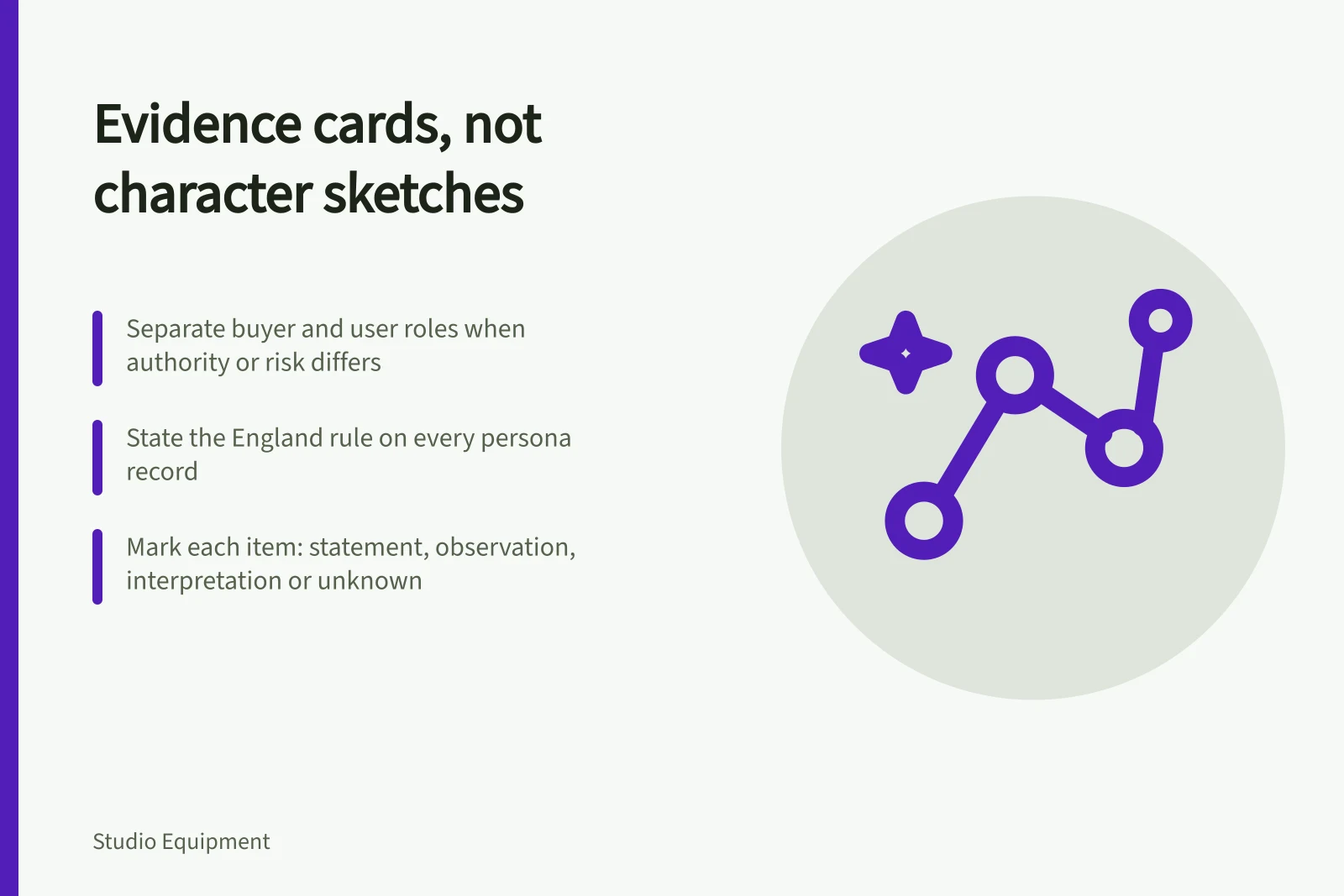
- Separate buyer and user roles when authority, work or risk differs between participants.
- State the England rule on every record, using the work location and field dates.
- Use an evidence card with fields for decision, context, evidence, counter-evidence, unknowns and expiry.
- Prevent a persona becoming a market claim by giving source counts and marking statement types.
- Anchor each card to named kit and a typical UK price, such as a Focusrite Scarlett 2i2 at about £199 or an Akai MPK Mini MK3 at about £89.
Keep buyer roles and operator roles apart
Studio equipment often involves several participants. The person holding the budget may never touch the kit. An editor may specify file compatibility with Pro Tools or DaVinci Resolve; an access lead may assess control layouts on a Roland FP-30X or the contrast on a Zoom H6 screen; finance may set lease terms.
Create separate evidence summaries when authority, work or risk differs. A broad 'content creator' character hides the hand-off.
The buyer choosing between a Focusrite Scarlett Solo at about £139 and a Scarlett 2i2 at about £199 is often not the person tracking vocals. The producer specifying a Shure SM7B at about £399 may not sign the order. Record both roles, and say which one your evidence covers.
State the England rule on every record: the proposed item would be delivered to and mainly used at a work location in England during the field dates. Do not use a social-media location or registered office instead.
The ONS business population dataset covers VAT/PAYE registered enterprises and local units, while the accompanying methodology describes classification and head-office limitations. Neither source identifies equipment buyers.
Use an evidence card instead of a character sketch
For each proposed group, record:
| Field | What belongs in it |
|---|---|
| Decision and authority | The purchase, hire, repair or keep-existing-kit choice, plus who can approve it. Example: replace a failed Focusrite Scarlett 2i2, repair a Yamaha HS5 monitor or defer a Universal Audio Apollo Twin X. |
| Kit in scope | Named models, connectors and software versions, with a typical UK price. Example: Ableton Live 12 Standard at about £319 or Logic Pro at about £199. |
| Alternatives rejected | The rival option and the reason it lost, such as an Akai MPK Mini MK3 at about £89 against a Novation Launchkey 49 at about £229. |
| Operating context | Task, workspace, collaborators and access constraints actually reported or observed |
| Evidence | Coded interview, survey or support-record identifiers and collection dates |
| Counter-evidence | Cases that do not fit the summary or point to another group |
| Unknowns | Compatibility, budget, safety, accessibility or timing still unverified |
| Expiry | Date or event that triggers fresh research |
A card should end on a purchase question, not a personality. 'Unknown whether the studio's Mac still supports a Thunderbolt 2 interface' is more useful than a paragraph about the buyer's musical taste.
The Government Service Manual says a research plan should identify objectives, participant types, recruitment and access needs in its guidance on planning a research round. Use those fields to judge whether the evidence card represents the intended population, not to pretend the research is representative.
Protect the people behind the summary
Remove unnecessary identifiers before synthesis. The Service Manual's participant-privacy guidance recommends minimising collected information, separating recruitment details from research material and planning deletion. Do not paste raw recordings, personal contact details, serial numbers or recognisable workspace images into the persona.
Accessibility cannot be reduced to a diagnosis field. Ask what adjustment would enable participation, offer alternative formats such as a large-print control guide, and record the effect on the equipment task.
Reaching the rear ports of a rack mixer or reading a licence dialog are equipment problems worth recording. Guidance on research with disabled people cautions against assumptions and advises researchers to speak directly to participants.
Prevent a persona becoming a market claim
Give every statement a source count and denominator within the study, while avoiding disclosure of small groups. Mark an item 'respondent statement', 'researcher observation', 'editorial interpretation' or 'unknown'.
A recurring concern in a purposive sample may justify another test; it does not establish prevalence across England. If three of five interviewees raise latency in Ableton Live, write three of five rather than 'creators care about latency'.
Version the card and retain the earlier evidence links when it changes. A return-policy revision, new operating system, discontinued connector or altered recruitment frame can make an otherwise careful summary stale. Equipment triggers count too: a firmware update, a Thunderbolt 2 interface reaching end of support or a price rise on a Shure SM7B.
The owner should set a review event and say whether contradictory evidence split, narrowed or retired the group. Silence from later participants is not confirmation.
Hold the persona if eligibility cannot be checked, evidence comes from one recruitment route, buyer and operator accounts conflict, or an identifiable participant could be reconstructed. Named research-ethics, statistical, privacy, accessibility and equality reviewers should approve the evidence design before it informs messaging, product requirements or procurement.
Before you act
- Give the record a functional label, not a made-up name.
- Create separate summaries when authority, work or risk differs.
- State the England rule on every record.
- Record decision, authority and kit in scope. Then add context, evidence, counter-evidence, unknowns and expiry.
- Remove unnecessary identifiers before synthesis.
- Version the card and set a review event.
Common questions
What should a persona record instead of a character sketch?
A persona should be a compact evidence record for a decision, not a fictional biography. It needs a functional label such as sole operator replacing a failed audio interface, not a made-up name, portrait or quotation that implies a real person was interviewed.
Which equipment details belong on the card?
Name the kit, the version and a typical UK price, for example a Focusrite Scarlett 2i2 at about £199, a Shure SM7B at about £399 or Ableton Live 12 Standard at about £319. Record the alternative the buyer rejected.
Why keep buyer and user roles apart in studio equipment research?
Studio equipment can involve several participants. The person holding the budget may not operate the kit; an editor may specify file compatibility; an access lead may assess controls; finance may set terms. Separate evidence summaries are needed when authority, work or risk differs.
When should you hold the persona?
Hold the persona if eligibility cannot be checked, evidence comes from one recruitment route, buyer and operator accounts conflict, or an identifiable participant could be reconstructed. Named reviewers should approve the evidence design before it informs messaging, product requirements or procurement.