Reviews
Reviewing studio equipment without mistaking specifications for results
Review studio equipment through exact models, controlled evidence, England supplier checks and safety gates without mistaking specifications for results.
A dependable studio review starts with a decision, not a shopping page. Name the output, room, operator and signal path. Add the delivery deadline and failure that matters. Test the smallest claim needed for that decision.
Specifications can narrow a field, but cannot prove a microphone sounds good, a light is safe in the intended rig, or a supplier resolves an incident.
This guide is for an England-based creator or small studio assessing equipment and its supply route. Many product records are global; much product and consumer law is UK or Great Britain in scope. Keep those geographies visible. No England-wide product ranking, price benchmark or provider-performance dataset is claimed here.
What to take away
- Start with the decision, not the shopping page, and name the output, room and failure that matters.
- Keep authority records, first-party statements, independent evidence, local results and user reports in separate columns.
- Check the contracting company behind a trading name before treating a supplier as verified.
- Compare only common fields with one definition and unit per row, and mark untested claims unknown.
- No bench or hands-on work was done for this guide, so that absence is a stated boundary.
Write the review card first
Freeze a one-page review card before collecting favourable material. It should contain:
- the exact model, variant, hardware revision, firmware and included components;
- the England workplace or home-studio context and eligible operators;
- the source, interface, computer, software, mount, power and network chain;
- the current equipment or manual process used as the baseline;
- required tasks and outputs, with units and acceptance limits;
- prohibited uses, audience exclusions and conditions that stop testing;
- evidence owners, reviewers, conflicts, dates and update triggers.
Do not silently substitute a near-identical model: a maker may publish several variants under one family page, while a retailer may bundle different cables, mounts or software. Save the product URL, data sheet and manual used for the decision.
The Shure MV7+ guide, RODE PodMic USB data sheet and Samson Q2U specification page show why fields, labels and units must come from the exact manufacturer's record. Their inclusion is not a recommendation.
Separate five kinds of evidence
Authority record. Use the directly responsible regulator or official body for a legal or safety boundary. The Office for Product Safety and Standards points businesses towards the rules for particular goods in its industry guidance. An authority page does not approve the model under review.
First-party statement. A manufacturer can document connectors, dimensions, software requirements and warranty wording, and a supplier can state its trading identity, service proposition and terms. Attribute these claims and record the page date. Do not rewrite promotional language as an independently observed fact.
Independent technical evidence. A useful laboratory report identifies the exact sample, apparatus, calibration, conditions, repetitions and uncertainty. A review that hides those details may be independent in funding but not reproducible in method.
Controlled local result. A studio trial can answer a tightly bounded task question when the configuration, source material, reference, operator and acceptance rule were set in advance. It applies to that tested arrangement, not every creator or room.
User report. Support tickets and consented feedback can reveal recurring questions or accessibility barriers. They are not automatically representative, and personal accounts do not establish electrical safety, durability or causal improvement.
Keep these columns separate in the evidence log. A polished comparison often becomes misleading when a supplier assertion is presented beside a measured result without its origin.
Check the supplier as well as the object
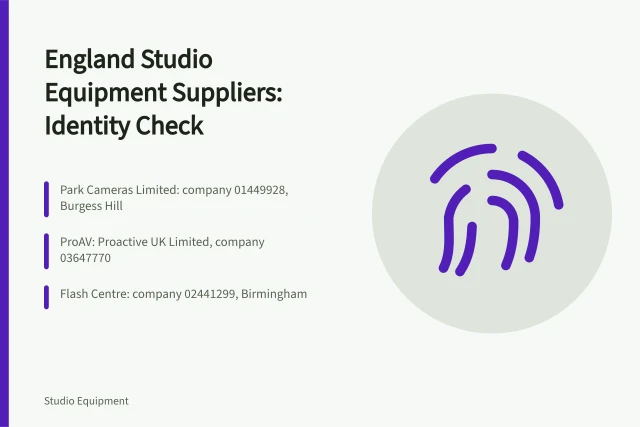
A website's trading name may differ from the contracting company. Match the name and company number in the terms to the official record. Companies House shows recorded status and registered office, but says filed information is not checked for accuracy.
The Warehouse Express Limited record can be matched to the legal identity in Wex Photo Video's terms. That match supports identity only. It says nothing about a product's availability, suitability or service quality.
For every candidate, ask for the same evidence pack: exact model and quantity, contracting entity, delivered configuration, VAT treatment, delivery commitment, inspection and acceptance, returns, warranty, repair route and support hours. It also covers liability, insurance, data roles, security assurance, accessibility evidence, export or deletion and end-of-life arrangements. Preserve unknowns. A missing answer should not become a neutral score.
England presence also needs careful wording. A registered office or shop address in England does not prove national coverage. A website saying it delivers in the UK does not prove stock or that it can meet a particular date. Verify the delivery postcode and service commitment in the written proposal.
Compare only common, decision-relevant fields
Start the table with the exact model in each column. Each row then needs one definition and unit. Do not compare packaged weight for one product with bare-unit mass for another, or frequency range with experienced speech quality. Keep a manufacturer's terminology where two labels may not mean the same thing.
Useful documentary rows might include:
- input and output connector type;
- operating-system and software-version support;
- physical dimensions and bare-unit mass;
- required power and mounting interface;
- included components;
- manufacturer-stated warranty route;
- published accessibility documentation;
- export, repair and end-of-life information.
Testing-dependent questions belong in a different section. Room pickup, handling transmission, colour consistency, thermal behaviour, control accessibility, driver stability, latency under load, repair experience and long-term reliability cannot be inferred from a specification span. Mark them unknown pending the declared test.
Price needs a common basis too. Record currency, whether VAT is included, access date, buyer type, quantity, included accessories, delivery, licences and contract period. A temporary web price is neither an England benchmark nor the total economic cost. If one quotation excludes a required stand, interface or captioning workflow, it is not like-for-like with a complete offer.
Declare desk, bench and hands-on work precisely
A desk review opens and logs documents. It can verify that a record exists and compare what it states. It cannot report feel, listening impressions, filming results, support quality or reliability.
A bench test uses a controlled input and measured output. Pre-register the unit identifier, firmware, apparatus, calibration, room conditions, gain staging, repetitions, tolerance and analysis code. Keep raw files and failed runs. Stop if the equipment behaves unexpectedly or the safety owner withdraws permission.
A hands-on workflow trial examines whether eligible operators can complete the defined task in the intended chain. Use synthetic assets first. If people, voices or images are required later, obtain the relevant permissions and privacy decision before capture. Record setup, errors, recovery and accessible operation. Do not generalise from one operator or turn preference into performance.
No bench or hands-on work was conducted for this guide. That absence is a boundary, not a minor footnote.
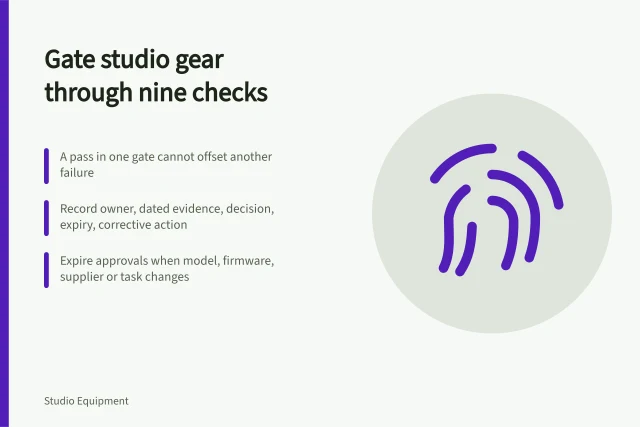
Keep assurance gates non-compensating
Product selection is not a points contest. A promising output cannot cancel missing safety evidence. HSE's PUWER overview covers suitability, maintenance, inspection and training considerations for work equipment. The responsible workplace and product-safety reviewers must decide the actual application.
Accessibility requires task evidence across controls, status feedback, documentation, output and support. The public-sector accessible communication formats guide is a useful planning reference, but it does not certify a private studio or device.
Connected equipment and companion software create separate privacy and security questions. Apply the ICO's data-minimisation principle to each collected field. Map accounts, telemetry, recordings, support access, processors, transfers, retention and deletion. NCSC's supplier-assurance questions help structure evidence requests by access and criticality; answering them does not guarantee security.
Rights review is independent again. Record licences for software, music, fonts, stock material, presets, photographs and captured performances. The IPO's digital-images copyright notice explains the copyright boundary for images found online. Appearance permission and data protection still need their own analysis.
Finally, examine contract, finance, support and exit. Buyer status affects which terms and routes apply. Any credit or finance promotion needs separate qualified review under the FCA's financial-promotions regime. Plan repair, data export, secure erasure and responsible electrical disposal; official WEEE guidance gives the waste boundary, not a supplier-specific route.
Score less, explain more
An overall score hides missing evidence and arbitrary weights. Prefer a decision table with four states: pass, fail, unknown and not applicable. Each state needs an owner and evidence link. Safety, accessibility, privacy, security, rights and contract failures stop the decision independently.
If numerical scoring is genuinely useful within a non-critical criterion, publish the scale, unit, weight, threshold and missing-data rule before results are seen. Never award the midpoint to an unknown. Present sensitivity: would a reasonable change in a weight alter the choice? If so, the result is fragile and the trade-off should be discussed rather than crowned a winner.
The CMA's current reviews and endorsements guidance collection reinforces the need for honest presentation. Disclose loans, gifts, affiliate arrangements, advertising, hospitality and prior supplier work beside the verdict. A disclosure does not rescue an unsupported conclusion.
Make a bounded decision
Finish with one of four outcomes: proceed to controlled trial, seek missing evidence, select under stated conditions, or hold. Name the configuration and population the conclusion covers. List what remains unknown and what would reverse the choice.
Set update triggers rather than claiming a timeless result. Reopen the file when the model, firmware, software support, supplier identity, terms, intended workflow, safety guidance or evidence gap changes. Recheck live sources on publication day. Until named specialists have signed their respective gates, every article in this cluster remains an editorial draft on hold.
Before you act
- Freeze a one-page review card before collecting favourable material.
- Save the exact product URL, data sheet and manual used.
- Match the trading name to the company number in the terms.
- Request the same evidence pack from every candidate supplier.
- Record currency, VAT, access date and included accessories for prices.
- Mark testing-dependent questions unknown pending the declared test.
Common questions
What should a review card contain?
It should hold the exact model, variant, hardware revision, firmware and included components, plus the England studio context, signal chain, baseline, required tasks with units and limits, prohibited uses, evidence owners, reviewers, conflicts, dates and update triggers.
Why keep evidence types separate?
A polished comparison becomes misleading when a supplier assertion sits beside a measured result without its origin. Authority records, first-party statements, independent technical evidence, controlled local results and user reports each carry different weight and belong in separate columns.
What does a Companies House match prove?
It supports identity only. Matching the trading name and company number to the official record confirms the contracting entity, but says nothing about a product's availability, suitability or service quality, and filed information is not checked for accuracy.
In this guide
- How studio equipment gets reviewed here, desk, bench and hands-on declaredBuild a studio equipment review with declared evidence, controlled tests, conflicts, safety gates and conclusions that stay within what was examined.
- Studio equipment providers: four England suppliers checked for creatorsExamine four non-ranked England studio-equipment suppliers through verified identity, relevant catalogues, terms and evidence still needed before buying.
- Creator studio equipment comparison: three USB-C and XLR dynamic microphones on shared specificationsCompare three exact USB-C and XLR dynamic microphones on shared manufacturer specifications, with testing-dependent qualities kept clearly unknown.
- Selecting studio equipment through safety, access, data and exit gatesGate a studio-equipment choice through separate safety, access, data, security, rights, contract, finance, support and responsible-exit checks.