Operations
Part of Operating a creator studio through explicit states and protected masters
Quality checks for a studio release candidate, from room to rights
Check an England studio release candidate for safe equipment, controlled files, accessible outputs, cleared rights, disclosure and recoverability.
Use this creator studio equipment quality checklist on one release candidate, not on a brand or theoretical setup. Every line needs pass, fail, unresolved or not applicable, plus an owner, evidence reference and time. A failed mandatory gate blocks release.
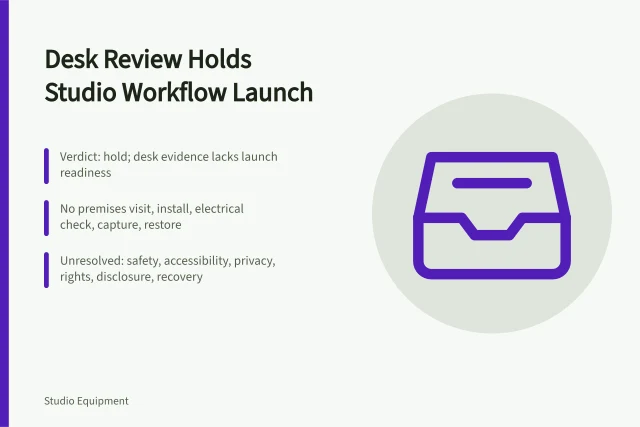
This checklist was assembled on 6 September 2026 for a spoken tutorial recorded in an England studio. It has not been executed and supplies no quality result.
What to take away
- Run the checklist on one release candidate, not a brand or theoretical setup.
- A failed mandatory gate blocks release, so unresolved items cannot be waived.
- A technical export can pass while the surrounding post fails, so treat both as one package.
- Store the file, captions, transcript, claims evidence, permissions and disclosures together.
- If evidence is stale, inconsistent or missing, mark unresolved and return the item to its last valid state.
Equipment and room
- Confirm the exact asset identifier, approved use, instruction set and software dependency.
- Inspect the visible condition, mount, power, cable route, ventilation and emergency stop route where relevant.
- Match inspection, maintenance and operator training evidence to the current setup.
- Record any substituted device or adapter and return it to safety review.
HSE's work-equipment guidance covers suitability, maintenance, inspection, information and training in Great Britain. Product-supply evidence belongs in a separate file. The OPSS industry directory routes businesses to the relevant Great Britain or Northern Ireland product rules.
Capture and file control
- Match operator, contributors, location, brief, settings and clock to the session record.
- Stop for a safety warning, missing permission or unexpected personal information.
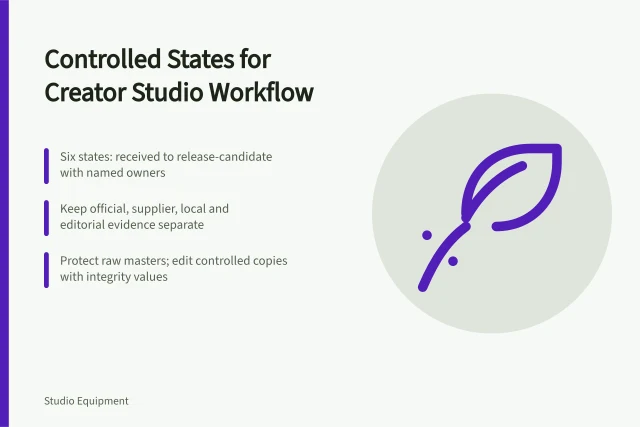
- Copy the raw file to controlled storage and protect the master from ordinary edits.
- Create a versioned working copy and log every export setting.
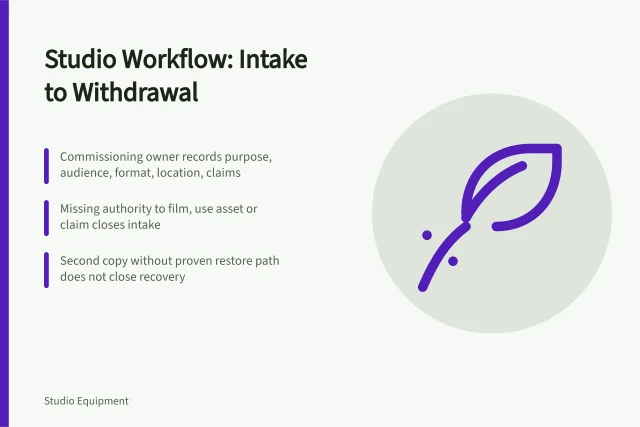
- Restore an authorised sample from backup to the nominated fallback.
The NCSC's backup page recommends checking restoration, not merely making a copy. Record what was restored, by whom and from which version.
Editorial and accessible output
- Compare the final picture and sound with the signed technical specification.
- Check that no edit changes the approved meaning or unsupported product claim.
- Review captions against the spoken content and names; compare the transcript with the final audio.
- Confirm that essential visual information has the required alternative.
- Test the actual player, controls, page and download route against the approved accessibility brief.
The government's accessible-formats guidance discusses final approved text, captions and supplier planning for public communications. It is useful evidence, not certification of this private workflow.
Permission and disclosure
- Link each image, track, graphic and contributor appearance to the exact permitted use.
- Check territory, channels, term, edits, paid-media use, credit and withdrawal route.
- Identify editorial, gifted, affiliate, sponsored or commissioned material.
- Confirm that the advertising reviewer approved both wording and placement.
The IPO's image copyright notice supports source-specific permission checks. ASA and CAP's influencer resource covers commercial relationships and ad labelling. Neither approval replaces the other.
Reconcile the release candidate
- Match picture, audio, captions, transcript, thumbnail, description and disclosure to one candidate identifier.
- Confirm that every factual or performance statement points to the approved evidence version.
- Check that a late edit has not removed a label, credit, warning or accessible alternative.
- Compare the upload preview with the approved package before the publisher records a decision.
A technical export can pass while the surrounding post fails. Treat the media file and its public presentation as one release package.
Release and exception record
The publisher checks that every mandatory reviewer has signed the same candidate version. Store the file, captions, transcript, claims evidence, permissions, disclosures, approval and public destination together. Record monitoring contact, correction owner, withdrawal authority and retention date.
If any evidence is stale, inconsistent or missing, mark unresolved and return the item to its last valid state. Do not convert an unresolved field into not applicable to meet a deadline.
Before you act
- Confirm the exact asset identifier, approved use and software dependency.
- Match operator, contributors, location, brief, settings and clock to the session record.
- Copy the raw file to controlled storage and protect the master.
- Review captions against the spoken content and names.
- Link each image, track and contributor appearance to permitted use.
- Check every mandatory reviewer has signed the same candidate version.
Common questions
What must every line of the checklist record?
Every line needs pass, fail, unresolved or not applicable, plus an owner, evidence reference and time. A failed mandatory gate blocks release. The checklist was assembled on 6 September 2026 for a spoken tutorial recorded in an England studio, but it has not been executed and supplies no quality result.
How should a late edit be handled before release?
Check that a late edit has not removed a label, credit, warning or accessible alternative. Match picture, audio, captions, transcript, thumbnail, description and disclosure to one candidate identifier. Compare the upload preview with the approved package before the publisher records a decision, and treat the media file and its public presentation as one release package.
What happens if evidence is stale or missing?
If any evidence is stale, inconsistent or missing, mark unresolved and return the item to its last valid state. Do not convert an unresolved field into not applicable to meet a deadline. The publisher checks that every mandatory reviewer has signed the same candidate version, and a failed mandatory gate blocks release.