Strategy
Planning a studio equipment decision around one production job
Plan an England studio-equipment decision around one production job, explicit evidence, qualified review, controlled tests and a reversible commitment.
A creator studio equipment strategy is a choice about a production system. It identifies the job that matters, the evidence needed, the option that will receive time or money and the work that will wait. Starting with a camera body, microphone or lighting kit usually leaves the team arguing about specifications before it has agreed what must improve.
This guide uses an England operating context for a defined workplace or delivery site. Product-safety, employment and some consumer rules may have wider Great Britain or UK scope, labelled beside the source.
Platform documentation is a supplier's global operating record, not England law. No equipment or channel was tested for this article, and it makes no price, performance, market-size or income claim.
What to take away
- Start with the production job that must improve, not with a camera body or microphone.
- Keep the existing setup if evidence shows the real problem lies elsewhere.
- Compare continued use, hire and purchase against the same production unit.
- Safety, legal, privacy and accessibility gates cannot be traded for a better average score.
- Set rollback and name who can order a return to the baseline before the trial.
Distinguish strategy from the documents beneath it
The strategy states which production capability the organisation will prioritise and why. A plan assigns work, evidence, owners, dates and gates. A channel decision determines how an approved explanation or offer reaches a defined audience. A campaign is a time-bounded execution. Treating these as synonyms produces a long task list with no defensible choice.
Start with one sentence:
For [defined operator and England site], we will test whether [route] meets [named production job] better than [current baseline], judged by [evidence], while [excluded work] remains unchanged until [review event].
Do not fill "better" with an invented percentage. State the failed output, rework event, inaccessible step or recovery gap that was actually observed. A team may discover that its present equipment is adequate and the problem lies in room treatment, training, software configuration or approval. Keeping the existing setup is a valid outcome.
Define the production unit and England boundary
Name the smallest repeatable job: a two-person interview, a product demonstration, a live audio session or an editing hand-off. Record the input, workspace, operator, collaborators, output file, intended audience and publishing route. Specify whether the equipment will be delivered to, installed at or mainly used from a workplace in England during the project.
Do not infer location from an IP address, accent, social profile or registered office. If sites in Scotland, Wales or Northern Ireland enter the project, report them separately or change the stated geography. UK-wide trade records and Great Britain workplace rules cannot be silently relabelled as England evidence.
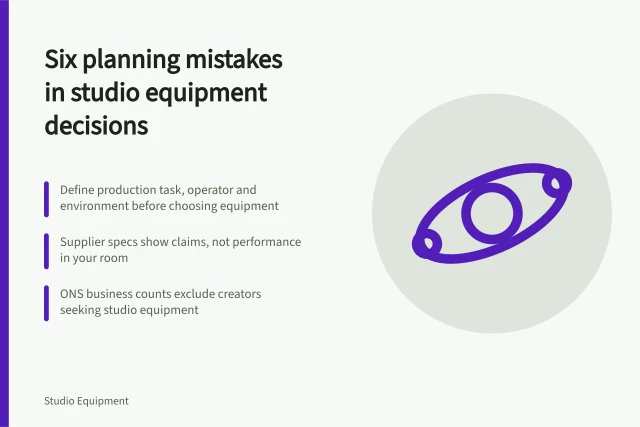
Broad official statistics do not solve this definition. The ONS UK business activity dataset covers VAT/PAYE registered enterprises and local units. Its quality and methodology information explains the IDBR, SIC and location limitations. It does not count creators planning to buy studio kit. Use the actual eligible workflow or buyer population for the decision.
Build a baseline that another person can reproduce
Observe the present job before proposing an upgrade. Use owned or specifically authorised material and record:
Build a reproducible baseline
- equipment identity, firmware and software version;
- connections, settings, room conditions and operator actions;
- output specification and acceptance check;
- interruption, repeated work and recovery steps;
- time and cost fields with unit, period and exclusions;
- access, safety, security and privacy restrictions.
Separate evidence classes. An official requirement is not an observed production result. A supplier specification establishes what the supplier publishes, not performance in the team's configuration. A controlled observation applies to the tested case. An editorial scenario states what could happen and names the trigger that would make it relevant.
Preserve failed and incomplete tests. Repeating only the successful take would hide the very workflow risk the strategy is meant to address.
Give one person authority to decide
Name the accountable owner who can commit budget, stop unsafe work and order a return to the baseline. Other roles contribute evidence rather than sharing vague collective ownership:
Give one person authority
| Role | Evidence owned |
|---|---|
| Operator | Setup record, output check, exception and recovery log |
| Technical lead | Compatibility matrix, version record and test cases |
| Procurement lead | Supplier identity, exact product, terms, support and exit evidence |
| Content owner | Claim file, rights, disclosure, correction and withdrawal route |
| Finance owner | Currency, VAT or tax assumptions, period, quantities and approval ceiling |
| Specialist reviewer | Pass, fail or unresolved decision within a named professional scope |
The 2025 Government Project Delivery Functional Standard applies to government organisations. Its treatment of governance, roles, planning, transition and disposal can still serve as a planning reference for a private team. It does not certify the resulting project.
Compare routes against the same job
Do not let the shortlist define the criteria. Compare continued use, repair or reconfiguration, temporary access or hire, and purchase against the same production unit. A managed service may be another route if its people, data, rights and contract boundaries are explicit.
Use a common decision record:
| Criterion | Evidence required |
|---|---|
| Functional fit | Named input, action, output and test result for the exact configuration |
| Safe use | Competent review of environment, instructions, installation, training and restrictions |
| Accessible operation | Task tested with relevant access needs, plus an alternative route |
| Compatibility | Ports, protocols, formats, operating systems and supported versions |
| Security and privacy | Accounts, data flow, access, updates, logging, incident and deletion evidence |
| Commercial position | Full scope, VAT treatment, licence, warranty, return, cancellation and liability |
| Exit | Export, wipe, return, repair, resale, disposal and baseline restoration |
Weights, scores and thresholds belong to the project. State who set them and why. Safety, legal, privacy, accessibility and security gates cannot be traded for a better average score.
Keep workplace use and product supply separate
HSE's PUWER overview explains Great Britain duties concerning suitable, maintained work equipment and adequate information and training. A qualified workplace-safety reviewer must determine how the rules apply to the actual arrangement, including hired or worker-owned equipment.
OPSS product-safety advice for businesses deals with manufacturers, importers, distributors and sellers and notes a different general-product-safety regime in Northern Ireland. Establish the legal entity and supply-chain role for the exact item. A badge, marketplace listing or positive review does not settle that question.
Networked cameras, control surfaces and computers also create account and update dependencies. NCSC guidance on purchasing devices securely is designed for organisational device procurement and helps frame supply-chain questions. It neither tests nor recommends creator equipment.
Plan the evidence, not just the installation
Create a versioned project record with prerequisites, task owner, source input, output evidence, acceptance criterion, blocking dependency and restart authority. Test first with synthetic signals and authorised footage or audio. Never use customer credentials, unreleased client material or personal data for convenience.
Functional testing should cover normal operation and a failure. For an audio interface, that might include the named input, host device, software version, sample configuration, exported file and recovery after a disconnected cable or lost account permission. This is an example of method, not a claim that any product will pass.
An accessible test covers the entire operator and audience journey. Government accessible communication guidance, updated 17 June 2026 and written for public communication, discusses captions, audio and alternative formats. A private publisher still needs qualified accessibility and equality review of its actual content and service.
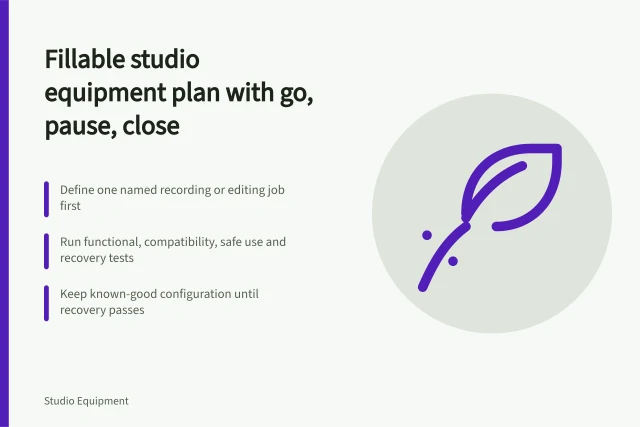
Set rollback before the trial. Keep the old configuration available, identify who can invoke the return, preserve known-good settings and prove that required assets can be restored. A project is not ready because the new setup worked once.
Choose channels on like-for-like evidence
The same verified compatibility explanation might be delivered through an owned help page, approved email, YouTube video or booked demonstration. Compare audience eligibility, format, correction speed, disclosure, privacy, rights, dependency and measurable action without inventing reach.
For electronic mail, the ICO's guidance on direct marketing using electronic mail was updated in April 2026. Research participation, service communication and promotion need separate records and a qualified PECR decision. An old customer address is not automatically a usable marketing contact.
YouTube's first-party upload page documents visibility, language and caption settings. Its paid promotion guidance requires creators to tell the platform about relevant product placements, sponsorships or endorsements and points them towards local obligations. These are global supplier controls. They do not prove that a video reaches England buyers or that its disclosure satisfies every UK requirement.
If content is advertising, the ASA's influencer marketing hub covers affiliate arrangements, commercial relationships and ad recognition. Evidence for objective product statements must also meet the ASA's misleading advertising guidance. A platform switch cannot repair an unsupported claim.
Protect personal data and media rights
Map contact details, account identifiers, recordings, analytics, support correspondence and exported files before collection. The ICO's data protection by design and default guidance was updated in February 2026 for the Data (Use and Access) Act 2025. A privacy reviewer should confirm purpose, lawful basis, transparency, minimisation, access, retention, processors, transfers and deletion for the actual workflow.
Maintain a rights record for music, graphics, fonts, product imagery, contributor appearances and client assets. A licence for one platform or campaign may not cover a help page, paid advertisement or later edit. Rights approval does not cure privacy or advertising failure, and vice versa.
Make cost and employment assumptions inspectable
Use blank formulas until current evidence is available. For every amount, record GBP or another currency, VAT or tax treatment, unit, quantity, period, source date, inclusion, exclusion and confidence. Compare cash outlay with staff or contractor time and the cost of maintaining the fallback. Do not treat gross revenue, clicks or attributed enquiries as incremental return.
If people are engaged to present, install, edit or support the setup, the contract label alone does not determine status. Acas explains Great Britain employment status categories, while HMRC provides the Check Employment Status for Tax service. Employment and tax specialists should review the real working arrangement separately.
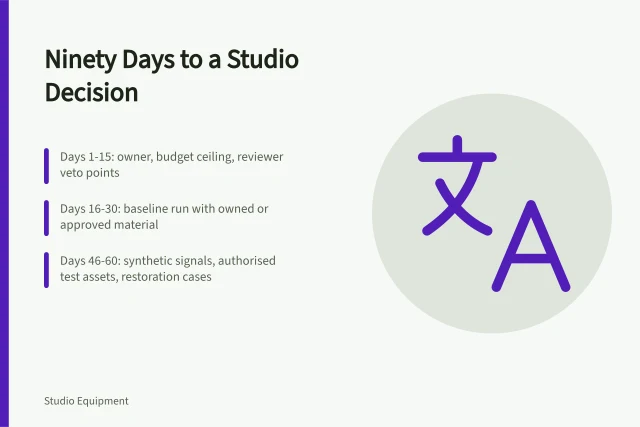
Use a ninety-day decision window carefully
A ninety-day project can create a useful forcing function, but the duration is an editorial planning choice rather than a benchmark. One practical sequence is:
Use a ninety-day decision window
- Define the job, geography, owner, baseline and specialist gates.
- Observe the current process and identify the smallest decision worth testing.
- Compare routes and suppliers with the same evidence grid.
- Test shortlisted configurations using approved materials and failure cases.
- Prepare accessible instructions, disclosure, correction and recovery.
- Run a limited authorised release or internal rehearsal, then choose adopt, revise or stop.
Each stage needs an entry condition, evidence output and pause rule. Missing safety documentation, unclear legal identity, inaccessible operation, unresolved data use or failed restoration blocks progression. The deadline does not convert an unknown into approval.
Close with a decision record
At the review, report the defined population, production unit, configuration, test dates, owners, evidence, exceptions and untested areas. Metrics need a numerator, denominator, period, timezone, exclusions and source query. Views, clicks, enquiries and sales are different events. None alone proves that the equipment caused a commercial or production outcome.
If a route proceeds, set its next inspection, evidence expiry, claim recheck and supplier-change trigger. If it stops, return or isolate equipment, revoke accounts, restore the baseline, preserve required records and delete data on schedule. Government guidance on electrical waste retailer responsibilities may be relevant to a seller's take-back route, but the exact role and jurisdiction require review.
The final recommendation should say what was observed, what came from a supplier, what remains an assumption and which scenarios were not tested. That is enough to support a bounded decision. It is not a performance promise, product endorsement or compliance certificate.
Before you act
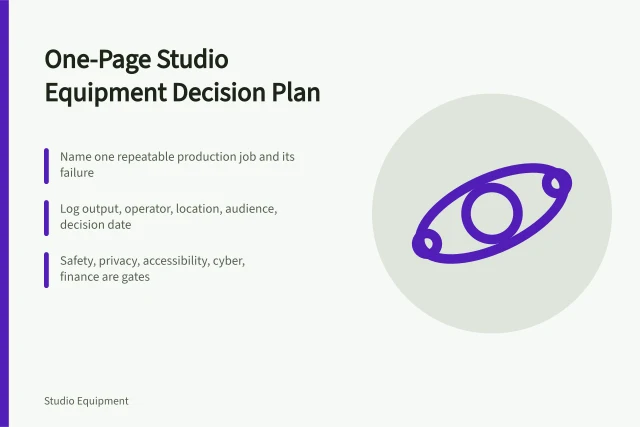
- Name the smallest repeatable production job and its output.
- Record the baseline so another person can reproduce it.
- Name one accountable owner who can commit budget.
- Separate workplace safety duties from product supply duties.
- Test normal operation and one failure before deciding.
- Set rollback and name who can invoke the return.
Common questions
What should the strategy sentence actually contain?
It names the defined operator and England site, the route to test, the named production job, the current baseline, the evidence used to judge, the excluded work and the review event. Do not fill better with an invented percentage; state the observed failed output, rework event or recovery gap.
Why can official business statistics not size this decision?
The ONS dataset covers VAT and PAYE registered enterprises and local units, and its methodology explains the IDBR, SIC and location limitations. It does not count creators planning to buy studio kit. Use the actual eligible workflow or buyer population for the decision instead.
How should workplace rules and product rules be handled?
Keep them separate. A qualified workplace-safety reviewer must determine how PUWER duties apply to the actual arrangement, including hired or worker-owned equipment. For product supply, establish the legal entity and supply-chain role for the exact item, since a badge or positive review does not settle that question.
In this guide
- A one-page studio equipment strategy that ends in a reversible commitmentChoose an England studio-equipment priority through a defined production job, evidence record, owner, safety gates and reversible decision point.
- A fillable studio equipment plan ending in go, pause or closeUse a fillable England studio-equipment plan with defined assets, owners, evidence gates, acceptance tests, spending controls and rollback routes.
- Six planning mistakes that derail a studio equipment decisionSix evidence-based planning mistakes can derail an England studio-equipment decision before purchase, publication, marketing or final disposal.
- Ninety days for a studio equipment project, with a decision at the endRun a controlled ninety-day England studio-equipment project with named owners, evidence gates, authorised tests, rollback and a final decision.