Tools and providers
Choosing studio tools and suppliers on a common evidence grid
Select studio tools and suppliers through a dated evidence grid covering workflow fit, safety, access, security, contracts, full cost and exit.
Choose a tool only after defining the production failure it must fix. A new microphone does not solve an untreated room, and editing software does not repair missing capture permission. For an England creator studio, the defensible route is a workflow record, a common evidence grid, a reversible trial and independent specialist gates.
This guide reports desk research completed on 6 September 2026. No software was installed, no equipment was bought or used, and no supplier service was tested. Product pages are attributed statements, not proof of performance, accessibility, safety or fitness for a particular production. Publication remains on hold for named qualified reviewers.
What to take away
- Define the production failure before choosing any tool, because new gear cannot fix an untreated room or missing permission.
- Use one common evidence grid so every candidate faces identical fields and supplier claims stay separate from reviewer judgement.
- Treat mandatory gates such as safety, privacy and accessibility as non-negotiable, and score preferences only after those gates pass.
- Read software evidence at edition level, since a product name alone does not show that your plug-ins, hardware or exports will work.
- Confirm the contracting supplier and the UK control gates, because registration and certificates do not prove competence or compliance.
Define one production route
Start with a single deliverable, such as a spoken tutorial recorded at a fixed desk, edited locally and published with captions. Name the operator, contributors, room, capture devices, computer, file formats, review path, destination and archive. Record the existing result with an approved test asset before considering a purchase.
Turn the problem into an acceptance test. For example, a proposed tool might need to accept the source format, preserve a recoverable master, support the required keyboard journey and export an approved caption format. State who judges each result and what evidence counts. Avoid loose goals such as professional sound or effortless editing unless a measurable definition accompanies them.
The existing setup is a real comparator. Keeping it, changing the room or revising the workflow may meet the need without adding another account, cable, licence or supplier dependency.
Set exclusions before researching products
Exclude any candidate that cannot identify its exact product or edition, supported operating environment, contract party, data route, essential export, update path or end-of-service treatment. For hardware, require the precise model and the documents appropriate to the supply role. Do not substitute a similarly named product's manual.
An exclusion is not a claim that a product is generally poor. It means the available evidence does not support this project's decision. Record the missing fact and an expiry date so a supplier can resolve it without receiving an automatic preference.
Separate mandatory gates from weighted preferences. Safety, legal permission, privacy, minimum accessibility and an achievable exit route cannot be offset by a convenient feature. Preferences such as interface layout or a non-essential accessory may be scored only after the mandatory questions pass.
Build a common evidence grid
Every candidate should face the same fields:
Common evidence grid fields
- Supplier, product, edition, territory, date
- Inputs, outputs, systems, network
- Acceptance tests, failure, recovery
- Accessibility for setup and exports
- Data roles, locations, retention, deletion
- Licence, users, installations, termination
- Security updates, access, incidents, support
- Full cost, renewal, training, migration, exit
Use supplier pages for what the supplier states. Use legislation or regulator material for external obligations. Use controlled, authorised trials for local observations. Keep reviewer judgement in a fourth column. Mixing these evidence classes creates false certainty.
Read software evidence at edition level
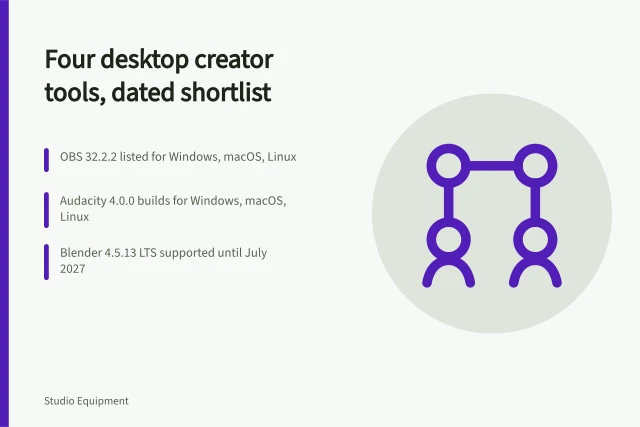
A software name is not a specification. The current OBS download page, for example, identified OBS Studio 32.2.2 and separate Windows, macOS and Linux routes on the research date. Its system-requirements page warns that basic compatibility does not guarantee a machine can stream or record with a chosen encoder, resolution, frame rate and scene.
The same discipline applies elsewhere. Audacity's official download record listed 4.0.0 for desktop systems. Blackmagic Design's DaVinci Resolve page identified edition 21 and described separate work areas for editing, effects, colour, audio and delivery. Blender's LTS record listed 4.5.13 LTS on 25 August 2026 and support for that branch until July 2027.
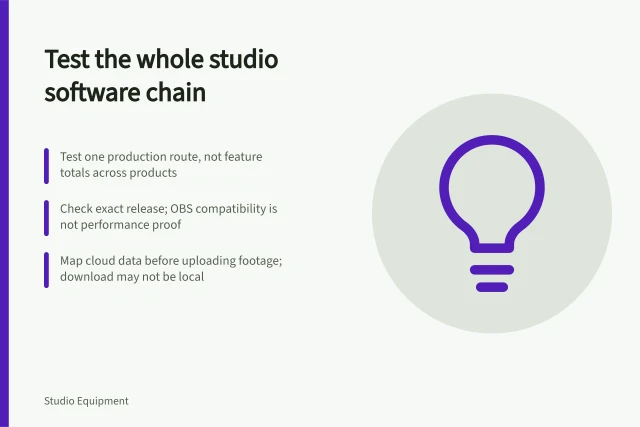
Those pages establish versioned supplier claims and distribution routes. They do not show that an England studio's plug-ins, assistive technology, codec set, hardware or export requirements work. Preserve the page, installer source and licence terms, then test only with synthetic or specifically authorised assets.
Compare hardware on one use case
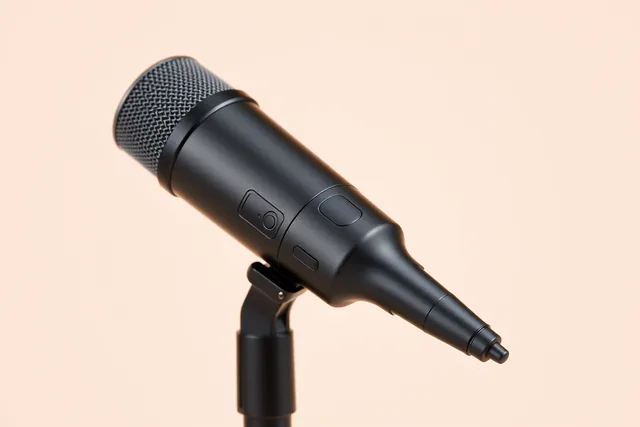
Do not compare a broadcast interface, a lavalier kit and a desktop USB microphone under a single best-microphone score. Hold the use case and criteria constant. For a desk-recorded voice workflow, useful common fields could include transducer type, polar pattern, computer connection, digital resolution, direct monitoring, physical controls, supplied mount or cable, software dependency and the unverified test list.
First-party records can populate that grid. RODE's GB NT-USB+ record states a cardioid condenser design, USB-C connection and headphone monitoring. Shure's UK MV7+ record identifies a dynamic cardioid microphone with USB-C and XLR outputs. Audio-Technica's AT2020USB-X manual documents a cardioid condenser USB model with monitoring, mix and mute controls, but does not establish England availability.
These differences help define trials; they do not establish sound quality in the intended room. A desk review cannot determine handling noise, speech intelligibility, driver behaviour, control accessibility or durability.
Investigate the supplier behind the page
Confirm the contracting entity and authority to sell or support the exact product. The official Companies House service can confirm public UK company information, but registration is not evidence of technical competence, solvency or good service.
Ask who handles delivery, installation, warranty, repairs, updates and end-of-life. Identify subcontractors, authorised resellers and the party receiving data or remote access. Record response evidence rather than awarding points for a logo or certificate whose scope and expiry were not checked.
The NCSC's supplier assurance questions cover governance, incident recovery, networks, data, offshoring, personnel, physical security and independent assurance. Tailor them to the tool's criticality. A small local editor with no network access presents a different exposure from a cloud collaboration service with raw client footage.
Keep the UK and GB control gates independent
Hardware supply and workplace use are separate reviews. OPSS product-safety advice distinguishes manufacturer, importer and distributor roles and Great Britain from Northern Ireland. HSE's PUWER overview addresses suitability, maintenance, inspection, information and training for work equipment in Great Britain. Neither page endorses a studio product.
If a service processes personal information on the organisation's instructions, establish the real controller and processor roles. The ICO's contract guidance covers required Article 28 terms, sub-processing, security assistance and return or deletion. A privacy policy alone does not supply those contractual terms.
Accessibility needs an acceptance journey, not a marketing badge. The government's inclusive communication guidance was written for government communicators but may inform briefs for accessible formats and suppliers. A named accessibility specialist must determine the actual legal and user requirements and test setup, core controls, help and outputs.
Software licences and equipment ownership do not settle content rights. The IPO's digital-images notice is official explanatory guidance, not permission to ingest or republish material. Document source assets, licence scope, contributor permissions, model training or analysis restrictions where relevant, exports and archive rights.
Advertising and consumer claims need their own approval. Section 3 of the CAP Code says objective claims capable of substantiation require documentary support before publication. Do not turn a supplier's compatibility statement or an incomplete local check into an independent performance claim.
Financing, credit or insurance can engage a further perimeter. The FCA's financial promotions page explains that product-specific rules may apply. Procurement approval, ordinary ad review and FCA review answer different questions.
Price the whole commitment without inventing a benchmark
Use a dated quotation for the exact UK customer, term and configuration. The comparison should show currency, VAT treatment, units, users, devices, storage, accessories, delivery, installation, training, support, renewal, price-change terms, migration and exit. Do not quote a page in another territory as an England payable total.
Keep cash and staff time separate. Estimate internal effort from named tasks and approved rates, not a fabricated typical creator wage. Add sensitivity for extra users, higher storage, replacement accessories and a failed migration. The finance owner should set an approval ceiling and a stop point before a trial begins.
Test reversibly, then decide
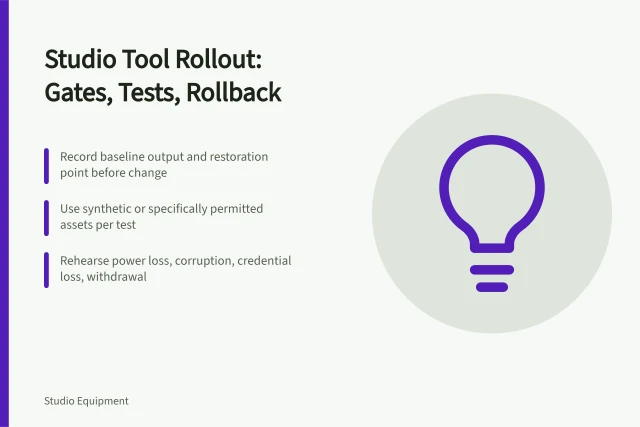
Use an isolated account or device and authorised sample assets. Capture installer and firmware versions, configuration, permissions and network access. Run the same input, edit, accessibility, export, restore and correction tasks against the existing baseline and each shortlisted candidate. Record failures as carefully as passes.
The implementation owner should rehearse rollback before production data enters the system. Export a usable project, restore it in the nominated fallback, remove test accounts and credentials, and obtain deletion evidence where relevant. A migration that cannot be reversed is not a low-risk trial.
Approve only when the workflow test passes and every mandatory specialist gate has a named decision, current evidence and expiry. Hold the selection if the legal entity, model, edition, data role, licence, safety file, accessible path, total commitment or exit remains unresolved. This method produces a defensible procurement record. It does not promise performance, uninterrupted service or compliance.
Before you act
- Name the operator, room, devices, formats, review path and archive.
- Record the existing result with an approved test asset first.
- Set exclusions for missing product, contract or data facts.
- Separate mandatory gates from weighted preferences.
- Keep supplier claims, regulator material and local trials in separate columns.
- Confirm the contracting entity and its support route.
Common questions
What should I do before buying any new studio tool?
Start with a single deliverable and record the existing result using an approved test asset. Turn the problem into an acceptance test covering source format, recoverable master, keyboard journey and caption export. The existing setup is a real comparator, and keeping it or revising the workflow may meet the need without adding accounts, cables, licences or supplier dependencies.
Why is a software product name not enough evidence?
A name is not a specification. The OBS download page identified version 32.2.2 and separate operating system routes, while its system requirements warn that basic compatibility does not guarantee streaming or recording with a chosen encoder, resolution, frame rate and scene. Preserve the page, installer source and licence terms, then test only with authorised assets.
How do UK control gates affect a studio purchase?
Hardware supply and workplace use are separate reviews. OPSS product safety advice distinguishes manufacturer, importer and distributor roles, and HSE PUWER covers suitability, maintenance, inspection, information and training for work equipment. If a service processes personal information, the ICO contract guidance covers required terms, sub-processing, security assistance and return or deletion.
In this guide
- Selecting studio software by testing the whole dependency chainSelect studio software through exact workflow tests covering versions, access, security, privacy, rights, exports, switching and total commitment.
- Creator studio equipment: a dated shortlist of four desktop toolsA dated, non-ranked shortlist of four exact desktop creator tools and a no-new-tool baseline, with first-party evidence and clear test limits.
- Studio USB microphone comparison: what three UK suppliers stateCompare three exact UK-listed desktop USB microphones through consistent supplier-stated criteria, explicit unknowns and a local-test requirement.
- Investigating a studio equipment vendor from identity to continuity evidenceInvestigate a studio-equipment vendor through identity, scope, safety, access, data, security, rights, renewal, commercial and exit evidence.
- Implementing a studio tool with authorised test assets and a way backImplement a studio tool with authorised test assets, versioned configuration, separate safety and rights gates, rollback and restart evidence.