Foundations
England's creator studio equipment market, defined before it is counted
Define England's creator studio equipment market, test demand without a false market total, compare access models and clear separate operating gates.
The practical starting point is a job, not a shopping list. Define what must be captured, who will use it, where the work happens and what a usable output looks like. Then decide whether approved existing equipment, purchase, hire or managed access is the least risky way to deliver it.
This guide does not claim an England market value. No official series reviewed on 5 September 2026 isolates creator purchases in England. It offers a defensible category boundary, a way to read public signals and an evidence-led route to a small commercial test. It is desk research. No product, supplier, service, price or buyer outcome was tested.
What to take away
- Define the production job and usable output before choosing equipment, purchase, hire or managed access.
- No official series reviewed isolates creator purchases in England, so the guide sets a category boundary instead of a market value.
- ONS business, trade and retail data can define populations and direction but cannot count niche equipment revenue.
- Estimate only the serviceable slice from verified eligible accounts, and label frequency and order value as assumptions until observed.
- Compare sale, hire, managed access and existing equipment against the same job, including support, returns and data erasure.
Define the category before counting it
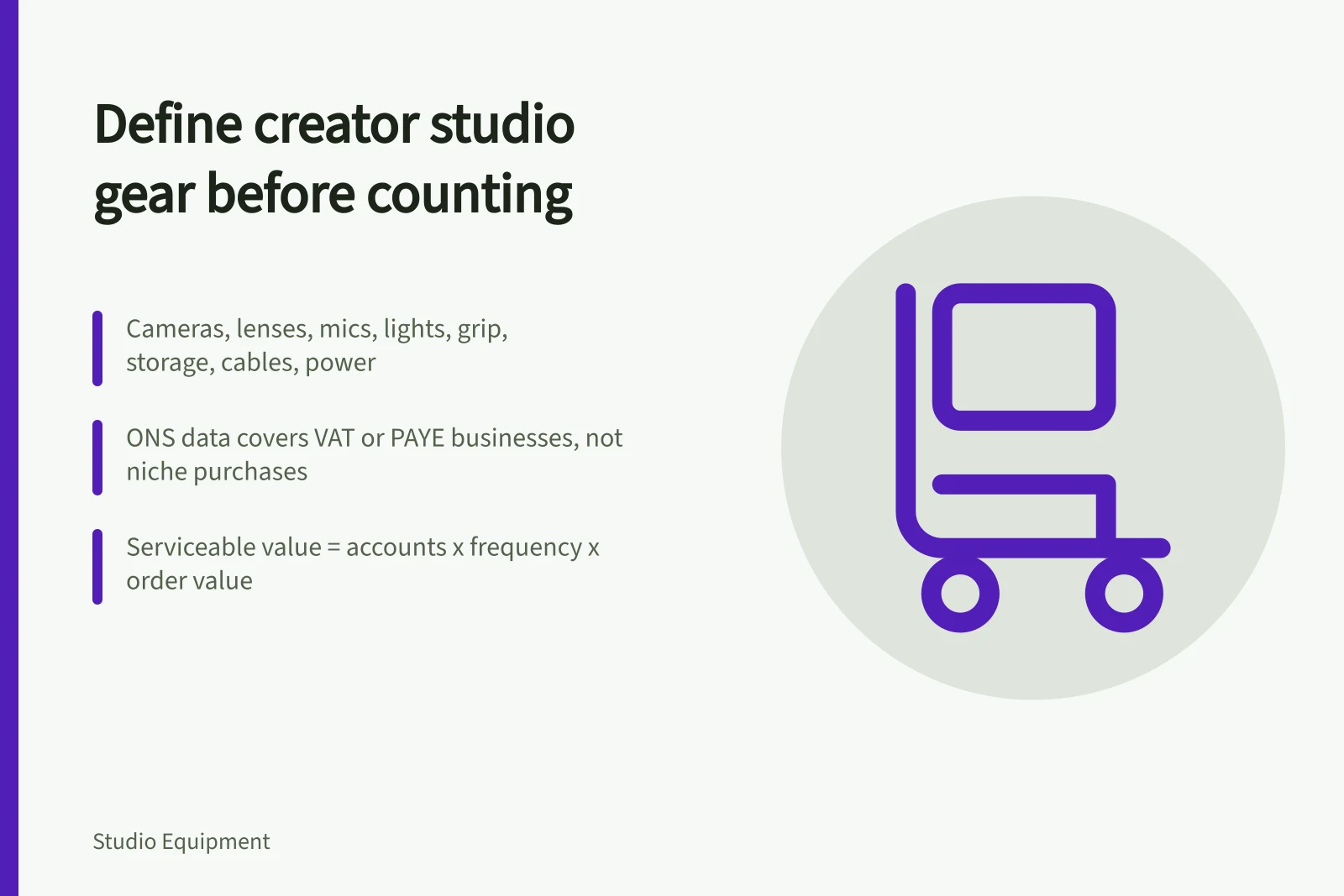
Here, creator studio equipment means physical products and closely tied access services used to capture, record, light, monitor, support, store or power still-image, audio and video production. Examples include cameras, lenses, microphones, interfaces, headphones, lights, stands, grip, backdrops, capture devices, recording media, storage, cables and power products.
General-purpose phones, computers, furniture and building work are excluded unless the approved workflow and invoice identify their studio function. Software-only services sit outside this market guide. A fixed studio and a portable kit can both qualify, but the buyer, delivery or service location must be in England for an England test.
The buyer population may include an adult creator, production business, charity, education provider or public body. Do not infer creator status from a social account. The supplier population is different: a seller, manufacturer, importer, rebrander, hire business or managed studio may be located elsewhere while serving an England customer. Legal duties follow the activity and product, not the marketing label.
Choose a consistent unit. For sales, use a completed eligible order or invoice line, net of refunds and cancellations. For hire, use an accepted contract for a defined booking period. For managed access, specify the session, included equipment and operator work. Report values in GBP, state whether VAT is included and keep buyer counts separate from transaction counts.
What official evidence can and cannot show
The ONS UK business activity, size and location dataset provides enterprises and local units by industry and geography.
The March 2025 snapshot mainly covers businesses registered for VAT or PAYE. Its quality and methodology page explains SIC 2007, registration coverage and location issues. These tables can support a carefully selected organisational denominator; they do not count creators, purchasers or studio-equipment revenue.
DCMS economic estimates are also broad. The department's methodology explains that many estimates use SIC groupings and that sectors can overlap. Creative-industry jobs or value cannot be converted into equipment spending by applying an assumed percentage.
Goods trade data answers another question. UK Trade Info publishes monthly UK imports and exports at detailed commodity-code level. The UK Trade Tariff classifies goods by their characteristics, so cameras, microphones, monitors and computing items can fall into different headings. Imports are not England retail sales. They can include stock, business inputs, re-exports and uses unrelated to content production.
The ONS internet retail sales dataset covers Great Britain by broad store type and is revised. It can describe the retail channel, not this niche. Likewise, the latest UK business-investment bulletin concerns non-financial assets at an economy-wide level. Preserve its UK geography and provisional-release status.
Use an evidence ladder for demand
Public records are useful for choosing where to look. They are weak evidence for whether an England buyer will accept a particular offer. Put signals in this order:
- Broad context:ONS business, retail and investment releases. These define populations and direction, not niche purchases.
- Product movement:UK trade records by stable commodity code and unit. They may show supply movement, not final use.
- Inspectable procurement:Contracts Finder records public opportunities and awards above its stated scope. An award is one procurement; an opportunity is not a purchase.
- First-party intent:eligible enquiries and approved quotes from a named England population, with duplicates and promotional responses removed.
- Completed behaviour:paid eligible orders or signed hire contracts, reconciled with refunds, cancellations and returns.
A signal should produce a next action. For example, a relevant awarded notice may justify interviewing similar public buyers. It does not justify ordering stock. A rise in a broad retail series may prompt a channel test, but it cannot supply an England conversion rate. Record the source population, period, query, owner and expiry for every signal.
Estimate only the serviceable slice
The most honest market model begins with inspectable records. For a chosen period, calculate net eligible value from accepted invoices, excluding or including VAT consistently, then subtract refunds, cancellations and duplicates. Count unique England delivery or service sites separately.
For planning before sufficient orders exist, use bounded scenarios:
serviceable value = verified eligible accounts x assumed purchase frequency x assumed net order value
Every input needs a unit, source, owner and replacement date. Label purchase frequency and order value as editorial assumptions until observed. Do not multiply every ONS enterprise by a convenient adoption rate. Suppress the result if buyer geography, category or return status is materially incomplete under a project-set data-quality rule.
The model should answer a decision such as how many units a capped pilot may hold, not provide a public headline. Finance reconciles the ledger, an analyst reviews duplicates and geography, and a UK statistics specialist signs the denominator. Refresh it when the offer, channel, tax treatment or product boundary changes.
Compare four access models on equal terms
An outright sale gives the buyer control and ownership, but creates stock, warranty, return and end-of-life questions. Short-term hire can suit intermittent work, yet adds booking, inspection, damage, cleaning and return dependencies.
Managed access can bundle equipment and operator work, though the contract must make responsibility and data handling clear. Approved existing equipment is the baseline and may remain the sound choice.
Compare all four against the same production job. Include acquisition or booking, setup labour, delivery, consumables, insurance, storage, downtime, maintenance, accessibility aids, support, returns, data erasure and exit. State the period and VAT basis. HMRC explains that VAT treatment depends on the precise goods or services and circumstances in its VAT guidance; a tax professional must decide the case.
If equipment is used at work, HSE says PUWER can apply whether equipment is owned or provided for hire. Suitability, maintenance, inspection, information and training need operational owners. That review does not replace consumer-product or electrical-safety decisions.
Treat product assurance as an operating system
Before an item enters a catalogue, identify the exact model, batch, manufacturer, importer and distributor. Retain the specification, instructions, safety information, conformity evidence, markings and recall route. OPSS's product-safety advice for businesses says those making, importing, distributing or selling consumer goods are responsible for safety, with duties varying by role.
Mains-powered products may engage the Electrical Equipment Safety Regulations guidance, which separates Great Britain and Northern Ireland. Connected consumer products require a product-specific assessment under the UK PSTI guidance, including applicable statement-of-compliance and update information. Electrical and cyber approval are separate gates.
End-of-life duties also depend on activity. The Environment Agency's EEE producer guidance covers certain manufacturers, rebranders, importers, distance sellers and online marketplaces. Retailers have separate electrical-waste responsibilities. A registration record does not prove product safety or quality.
Design the customer journey around evidence
For distance sales, the government lists pre-contract information and cancellation requirements in its online and distance-selling guidance. The exact consumer, business and hire position needs legal review. Publish identity, total price, delivery, condition, compatibility limits, cancellation route, warranty basis and support boundary in a form the customer can keep.
Objective claims require substantiation. CAP's misleading-advertising guidance warns about inaccurate feature claims. CMA unfair-commercial-practices guidance applies to business-to-consumer conduct from 6 April 2025. Neither a disclaimer nor a supplier brochure makes an unsupported claim safe.
Collect only information required to quote, fulfil and support. The ICO's data-protection principles guidance is under review following the Data (Use and Access) Act 2025. Recheck it on publication day. Separate service communications from direct marketing and apply current ICO marketing guidance.
Licence product photography, diagrams, demonstrations and manual extracts. The IPO's digital-images copyright notice explains that online availability does not remove copyright. Accessibility also needs planned evidence: test the shopping or booking path, instructions, captions and support with users or specialists. Government accessible-format guidance offers practical production considerations, not a private-sector compliance guarantee.
A controlled route into 2027
Start with one buyer population, one England service area and one workflow. Interview eligible participants without claiming representativeness. Test the existing-equipment baseline, then one acquisition model. Set a stock or contract ceiling, full-cost budget, acceptance test, review date and named rollback owner.
The commercial gate requires accepted orders or contracts from the defined population. Product safety, workplace use, consumer law, advertising, WEEE, privacy and PECR, IP, accessibility, cyber, procurement and contracts, credit permissions, finance and tax each retain a separate qualified reviewer. None can compensate for another.
Pause if supplier identity is uncertain, safety evidence missing, connected-product support unclear, a claim lacks substantiation or an accessible journey fails. Pause if personal data cannot be minimised, finance permissions unresolved, or exit rehearsal cannot recover records and erase devices.
A 2027 launch decision is justified by a complete evidence file and a recoverable test, not an invented England market total.
Before you act
- Define the job, users, location and usable output first.
- Set a consistent unit and state the VAT basis.
- Keep buyer counts separate from transaction counts.
- Record source, period, owner and expiry for every signal.
- Confirm PUWER duties for equipment used at work.
- Retain model, batch, conformity evidence and recall route.
Common questions
Can ONS business data be used to size creator equipment spending in England?
No. The ONS business activity, size and location dataset counts enterprises and local units by industry and geography, mainly from VAT or PAYE registration. It can support an organisational denominator but does not count creators, purchasers or studio-equipment revenue, so it cannot be converted into spending.
What is the difference between a procurement signal and a completed purchase?
Contracts Finder records public opportunities and awards above its stated scope. An award is one procurement and an opportunity is not a purchase. Only paid eligible orders or signed hire contracts, reconciled with refunds, cancellations and returns, count as completed behaviour in the evidence ladder.
How should a serviceable value be estimated before enough orders exist?
Use bounded scenarios: verified eligible accounts multiplied by assumed purchase frequency and assumed net order value. Every input needs a unit, source, owner and replacement date. Label frequency and order value as editorial assumptions until observed, and suppress the result if geography, category or return status is incomplete.
In this guide
- Why there is no official studio equipment total, and how to build a bounded oneLearn why England has no official creator studio equipment total and how to build a bounded estimate from eligible orders without misusing broad data.
- Creator studio equipment business models compared on equal criteriaCompare equipment purchase, hire, managed access and an existing-kit baseline using the same evidence, safety, consumer, tax and exit criteria.
- Before selling studio equipment in England, build the safety fileA staged England entry checklist for studio equipment, covering evidence, product roles, safety, consumer terms, privacy, access, tax and exit.