Foundations
Part of England's creator studio equipment market, defined before it is counted
Before selling studio equipment in England, build the safety file
A staged England entry checklist for studio equipment, covering evidence, product roles, safety, consumer terms, privacy, access, tax and exit.
Use this checklist before an England sales, hire or managed-access pilot. It was reviewed on 5 September 2026, is unranked and excludes product recommendations. A failed safety, consumer, privacy or finance gate cannot be offset by strong demand evidence.
What to take away
- A failed safety, consumer, privacy or finance gate cannot be offset by strong demand evidence.
- Record the contracting entity and its product role before any stock is offered for sale.
- Keep supplier identity, conformity evidence, markings and a recall route for each model and batch.
- Cyber review is separate from electrical approval for connected consumer products.
- Launch only when every specialist signs its own gate, and pause on any failed gate.
1. Freeze the offer and buyer
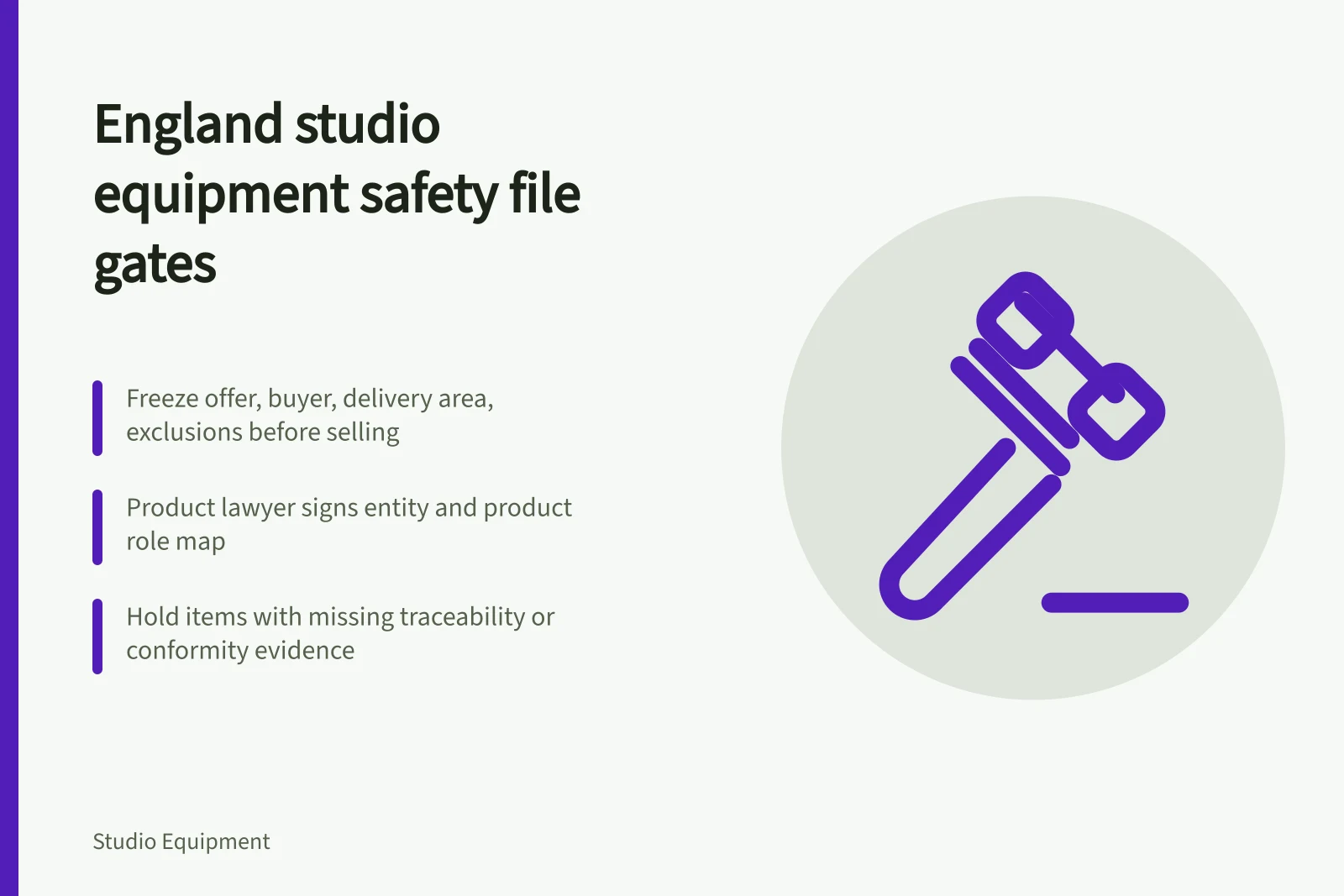
Write down the product groups, condition, sale or hire unit, England delivery area, consumer or business customer, exclusions and existing-equipment baseline. The commercial lead owns the record. Stop if a bundle cannot be separated into goods, services, credit and data-processing elements.
2. Identify the legal entity and product role
Record the contracting entity and whether it manufactures, imports, rebrands, distributes, hires or merely introduces. OPSS notes that businesses can carry different safety duties across a supply chain in its business product-safety guidance. A product lawyer must sign the role map before stock is offered.
3. Build the safety file
For each exact model and batch, retain supplier identity, specification, instructions, conformity evidence, markings, risk information and recall route. The Electrical Equipment Safety Regulations guidance separates Great Britain from Northern Ireland. Treat used, modified, mains-powered and battery products according to their actual characteristics. Hold any item with missing traceability.
4. Check connected-product security
For an internet or network-connected consumer product, assess the current PSTI product-security guidance. Record the statement of compliance, update period, vulnerability route, setup permissions and secure reset. Cyber review is separate from electrical approval.
5. Decide WEEE roles before launch
The Environment Agency defines UK EEE producers to include certain manufacturers, rebranders, importers, distance sellers and online marketplaces in its producer-responsibility guidance. Retailers also have electrical-waste takeback and information duties. Keep registration or scheme evidence and stop sales if the responsible entity is unresolved.
6. Make the offer truthful and usable
Substantiate objective compatibility, performance and availability claims before publication. CAP's misleading-advertising advice points marketers to evidence for objective claims. CMA guidance covers unfair commercial practices. A legal reviewer should approve descriptions, total-price presentation, delivery, cancellation, warranty and returns for the chosen customer type.
7. Protect enquiry and support data
Collect only the fields needed to quote, fulfil and support. The ICO's data-protection principles guide is under review following the Data (Use and Access) Act 2025, so check publication-day guidance. Marketing consent and service messages need separate treatment under current direct-marketing guidance.
8. Verify rights and accessibility
Licence every photograph, diagram, manual extract and demonstration clip. The IPO warns that most online images are likely protected in its digital-images copyright notice. Test keyboard ordering, labels, contrast, captions and alternative formats with disabled participants or specialists; government accessible-format guidance is a useful production reference, not a private-sector compliance certificate.
9. Reconcile contracts, tax and finance
Write responsibilities for delivery, inspection, damage, support, security incidents, withdrawal, liability, renewal, export and deletion. Confirm VAT and capital treatment with a UK tax adviser using current HMRC capital-allowance guidance. Obtain an FCA permissions decision before arranging regulated credit or hire.
10. Run a recoverable pilot
Use synthetic accounts and specifically authorised media. Set an order ceiling, evidence owner, acceptance test, complaint route, recall contact and rollback date. Launch only when every specialist signs its own gate. Pause on an unsafe item, misleading claim, inaccessible journey, unexplained data transfer, unapproved finance route or failed return rehearsal.
Before you act
- Freeze the offer, buyer and England delivery area.
- Map the legal entity and product role.
- Build the safety file for each model and batch.
- Decide WEEE roles before launch.
- Substantiate compatibility, performance and availability claims.
- Run a recoverable pilot with an order ceiling.
Common questions
What must be recorded before stock is offered?
Record the contracting entity and whether it manufactures, imports, rebrands, distributes, hires or merely introduces. A product lawyer must sign the role map before stock is offered, and the commercial lead owns the offer record covering product groups, condition and exclusions.
How should used or modified equipment be treated?
Treat used, modified, mains-powered and battery products according to their actual characteristics. For each exact model and batch, retain supplier identity, specification, instructions, conformity evidence, markings, risk information and recall route. Hold any item with missing traceability, and separate Great Britain from Northern Ireland requirements.
When can the pilot launch?
Launch only when every specialist signs its own gate. Use synthetic accounts and specifically authorised media, and set an order ceiling, evidence owner, acceptance test, complaint route, recall contact and rollback date. Pause on an unsafe item, misleading claim, inaccessible journey, unexplained data transfer, unapproved finance route or failed return rehearsal.