Reviews
Part of Studio monitors for small rooms UK: top picks for bedroom studios
Studio monitors for small rooms UK: top picks for bedroom studios
Which studio monitors suit small UK rooms, how room correction and bass control work on plasterboard walls, and what to check before you buy a pair.
What to take away
- Driver size should follow the distance between your ears and the speakers, not the size of your ambitions.
- In a small room, correction beats extensiona speaker that can be tuned to its position usually sounds more honest than a bigger one in a corner.
- Plasterboard partitions, common in modern British homes, let low frequencies reach the next room, so bass control is a household issue as much as a mixing one.
- Correction works best when the speakers are placed sensibly first, because software cannot fix a cabinet pressed into a corner.
- Buy the calibration route at the same time as the speakers. Retrofit kits often cost more than the gap between two models.
Why a small room changes the shortlist
Most nearfield monitors are built for close listening rather than for filling a space. It is worth checking how nearfield monitors are defined before you shortlist, because the listening position matters as much as the cabinet.
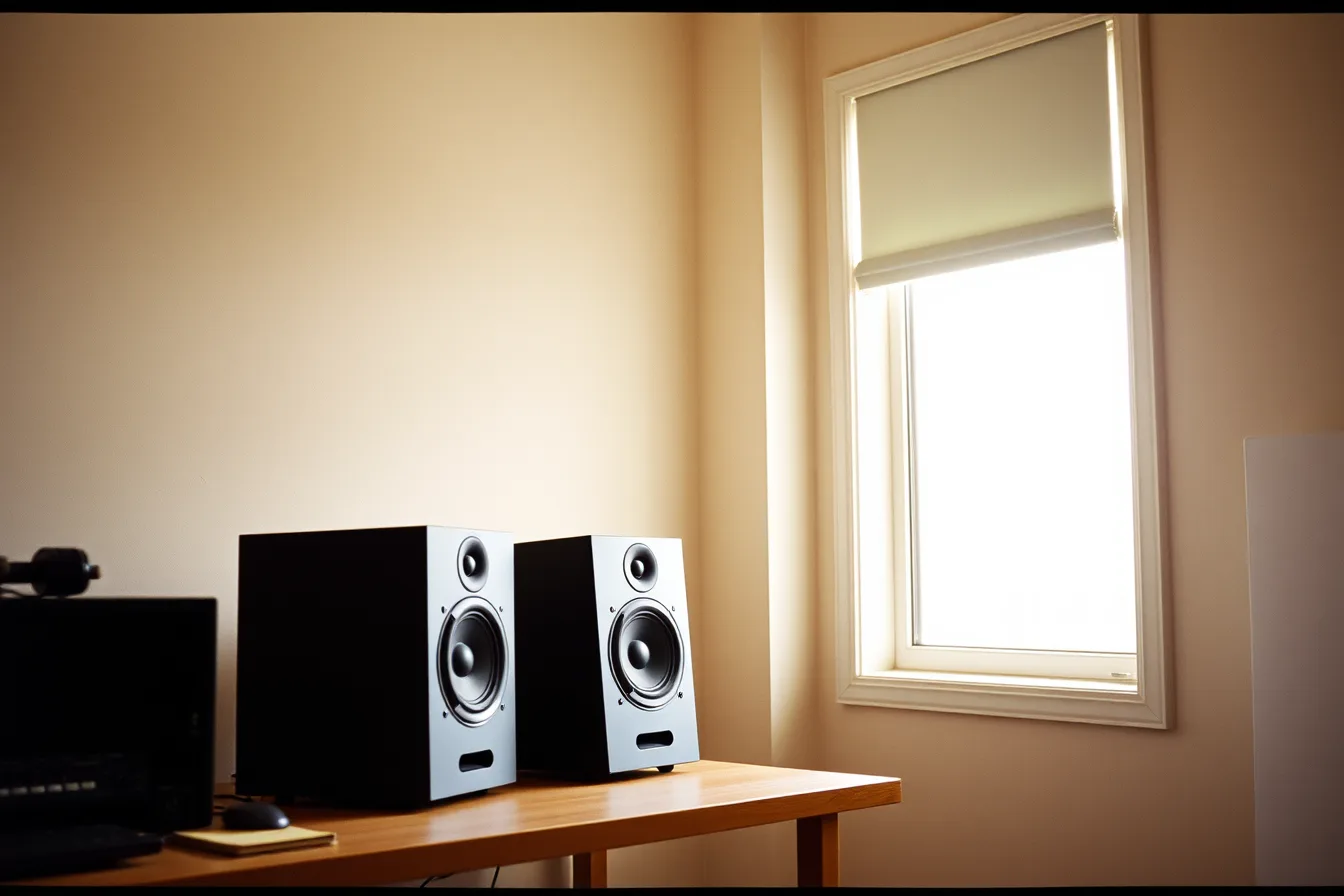
Early reflections and corner loading both flatter the low end. A modest speaker with a bass tilt switch can sound more trustworthy than a larger one with no way of accounting for the wall behind it.
In a box room or a single bedroom you are almost always inside the near field, which is why the room, not the badge, decides what you hear.
A pre-purchase sequence for a bedroom studio
A pre-purchase sequence
- Fix the listening position first. Sit where you will actually work and note how far your ears are from each speaker.
- Decide how the speakers will stand. A solid desk with isolation pads works; a rattling shelf does not.
- Choose the correction route. Onboard DSP with a supplied measurement microphone keeps the calibration inside the speaker.
- Check the outputs you already have. Balanced inputs want a balanced source, so read this buyer's checklist for choosing an audio interface for a home studio before you order.
- Agree the household rules before the first long sessionwhen the monitors go on, when headphones take over, and who needs warning.
- Note the return window in your calendar. A fortnight in a small room tells you more than a showroom demonstration.
Monitors to shortlist by room type
The table below is a shortlist, not a ranking. Model numbers and bundles change, so confirm what is in the box with the dealer before you buy.
Monitors by room and desk position
Box room, corner desk
- Driver size
- 3 to 4 inches
- Correction needed
- Onboard DSP with mic
- Example models
- IK Multimedia iLoud MTM
Small bedroom, space behind
- Driver size
- 5 inches
- Correction needed
- Low-frequency tilt or kit
- Example models
- Neumann KH 80 DSP; Genelec 8330A
Larger spare room or garage
- Driver size
- 6.5 to 8 inches
- Correction needed
- Measurement kit storing profile
- Example models
- Neumann KH 150; Genelec 8340A
| Room and desk position | Driver to look for | Correction to insist on | Models with a measurement route |
|---|---|---|---|
| Box room, desk close to a corner | 3 to 4 inches | Onboard DSP with a supplied calibration microphone | IK Multimedia iLoud MTM |
| Small bedroom, space behind the speakers | 5 inches | Low-frequency tilt and a desktop filter, or a full measurement kit | Neumann KH 80 DSP with MA 1; Genelec 8330A with GLM |
| Larger spare room or converted garage | 6.5 to 8 inches | Measurement kit that stores a room profile in the speaker | Neumann KH 150 with MA 1; Genelec 8340A with GLM |
Correction is only as good as the measurement it is given. Keep the microphone in the same spot between runs, and re-calibrate if the desk moves.
If you would rather set filters by ear, several Adam Audio models offer onboard EQ without a measurement kit.
Bass control, plasterboard and the neighbours
Low frequencies pass through lightweight partitions more readily than through solid masonry, which is why a neighbour hears the bass line but not the vocal. How soundproofing works comes down to mass, isolation and closing the gaps, not to covering the wall in foam.
Acoustic treatment of a small room is a different job. Absorption panels and corner traps make what you hear at the desk more even, but they do very little for the person on the other side of the wall.
A quick check: play a familiar bass-heavy track at your normal working level and walk into the next room. If you can follow the bass line through the wall, the problem is transmission rather than your speakers. This guide to how to soundproof a room for recording sets out the cheap steps in order.
Common questions
Are 5-inch monitors too big for a bedroom?
Usually not, if the desk has space behind the cabinets and the speaker has a low-frequency trim. A five-inch nearfield at a sensible distance often suits a bedroom better than a tiny box that has to work hard.
Do I need a measurement microphone?
Only if your speakers accept one. Onboard correction with a supplied microphone is the simplest route, and a speaker without DSP can still be placed well by ear.
Will room correction stop the neighbours hearing my bass?
No. Correction shapes what reaches your ears and can tame excess low end, but transmission through a party wall is a soundproofing problem. Expect to add mass or change your working hours.
Where should monitors sit in a small room?
Symmetrically, with the tweeters at ear height and both cabinets the same distance from you. Keep the desk out of the corner where you can, and avoid pressing rear ports against a wall.