Measurement
Part of Measuring a creator studio without rewarding shortcuts
Five studio metrics from capture readiness to restore test
Define England studio metrics for readiness, accepted outputs, corrections, accessible packages and restore tests without inventing benchmarks.
Creator studio equipment key metrics should answer operating decisions, not decorate a monthly report. For a fixed-desk tutorial workflow in England, begin with readiness, accepted output, correction, accessible delivery and recovery. None is an England industry benchmark.
Each definition below is a blank contract. No studio records, audience results or device performance were measured.
What to take away
- Five separate studio metrics cover readiness, first-review acceptance, correction, accessible delivery and restore testing.
- Each metric needs a clear numerator, denominator, unit and documented exclusions before use.
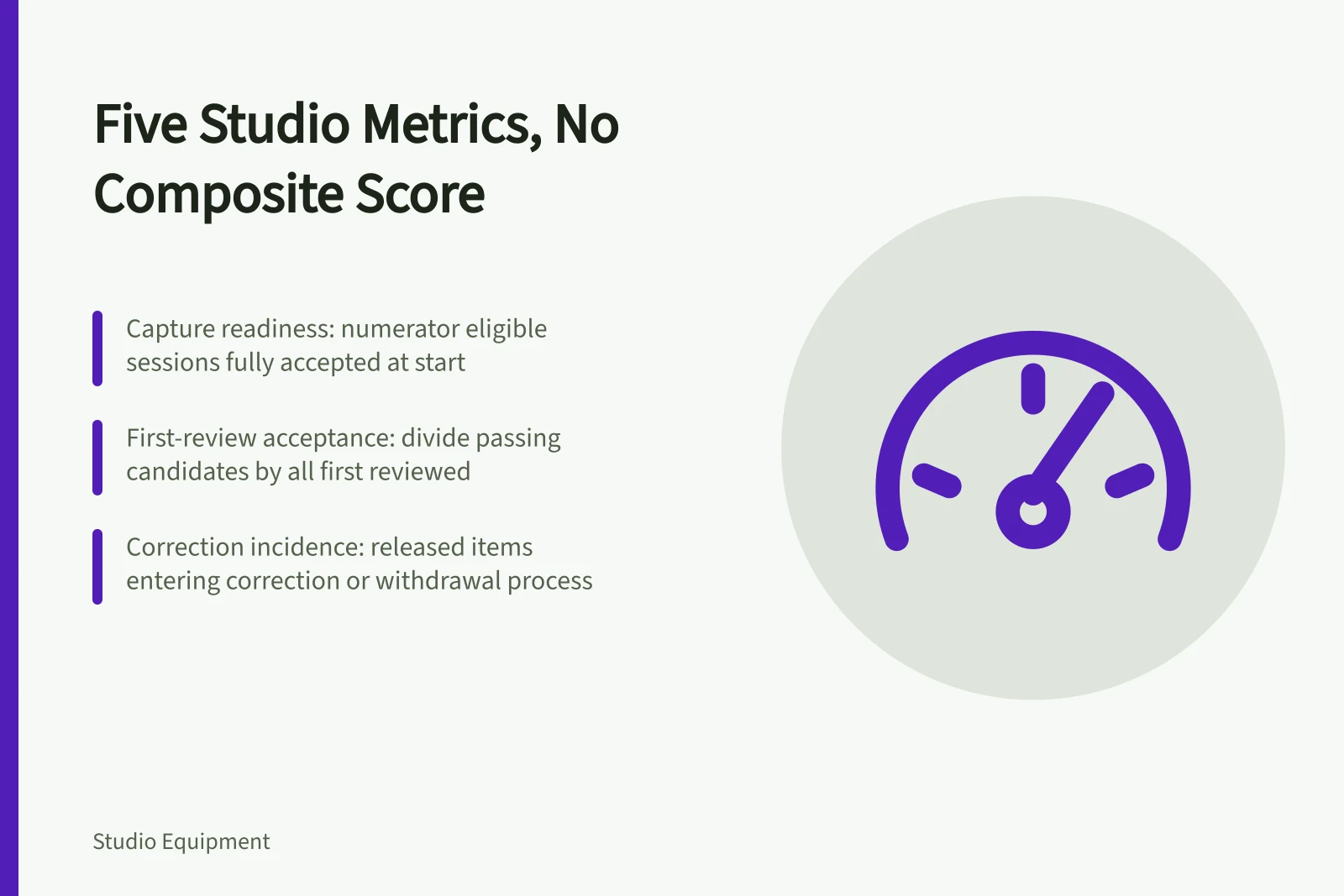
- Do not blend the five results into a single composite score.
- A low correction incidence may reflect missed reports rather than high quality.
- Give each metric an owner, baseline, uncertainty note, threshold and review trigger.
Capture readiness
Question: how often did a planned recording reach its start time with every mandatory input accepted?
Capture readiness gate
- Current asset record complete
- Safety decision complete
- Contributor authority complete
- Storage check complete
- Approved brief complete
Numerator: eligible sessions whose current asset record, safety decision, contributor authority, storage check and approved brief were complete at the agreed start. Denominator: all eligible sessions scheduled in the reporting period, including held sessions. Unit: percentage of sessions. Record the England location rule, timezone, exclusions, evidence owner, query version and missing fields.
Do not remove cancellations caused by missing evidence. The Government Data Quality Framework treats completeness, uniqueness, consistency, timeliness, validity and accuracy as different dimensions. A complete readiness form can still contain a wrong asset identifier.
First-review acceptance
Question: what proportion of release candidates passed the first documented quality review without correction?
Count a candidate only when picture, sound, caption, transcript, disclosure and rights records refer to the same version. Divide candidates passing their first review by all candidates first reviewed during the period. Keep held and failed work in the denominator. Report reasons separately rather than turning them into extra metrics.
This measure describes production control. It says nothing about audience response or whether the equipment caused better work.
Correction incidence
Count released items that entered a documented correction or withdrawal process, divided by eligible released items. Fix the observation window before reporting and distinguish a spelling correction from safety, privacy, rights or misleading-claim escalation. A low result may reflect missed reports rather than high quality, so publish monitoring coverage and unresolved cases beside it.
Correction types to separate
Spelling correction
- Severity
- Low
- Reporting
- Separate
- Monitoring
- Publish coverage
- Unresolved cases
- Publish
Safety, privacy, rights or misleading-claim escalation
- Severity
- High
- Reporting
- Separate
- Monitoring
- Publish coverage
- Unresolved cases
- Publish
Accessible-package completeness
The numerator is eligible releases delivered with every required accessible component in the approved brief. The denominator includes all releases covered by that brief. Define whether captions, transcript, alternatives and player checks are mandatory for each format. Government accessible-formats guidance can inform planning, but its public-communications setting does not certify a private studio output.
Restore-test acceptance
This is the share of authorised restore exercises that met the locally approved file identity, integrity, access and elapsed-time conditions. State the sample, backup version, clean destination, start and stop events, exclusions and tester. The NCSC's logging guidance recommends designing records around incident questions. Protect the log from inappropriate access or alteration.
Read measures together without blending them
Keep the five results on separate lines. A session can be ready on time yet produce a candidate that fails review. A complete accessible package can later need correction. A successful restore exercise does not prove that every master is recoverable. These tensions are useful because they point to different owners and remedies.
Add a short exception note beneath each result: missing records, unusual workload, changed equipment, altered workflow and any decision that could affect the next period. Do not calculate a single composite score. Such a score would allow a strong operational result to mask a failed rights, safety or accessibility gate.
Decide before setting a target
Give each metric an owner, local baseline period, uncertainty note, decision threshold and review trigger. A changed workflow, asset class, definition or collection route breaks the series until comparability is assessed. Use the measure to investigate a decision, not to reward teams for shrinking denominators or avoiding difficult work.
Before you act
- Define numerator and denominator for each metric.
- Record location rule, timezone, exclusions and evidence owner.
- Keep held and failed work in the denominator.
- Publish monitoring coverage and unresolved cases beside correction incidence.
- State sample, backup version, destination and tester for restore tests.
- Add an exception note beneath each result.
Common questions
What should a capture readiness metric measure?
It measures how often a planned recording reached its start time with every mandatory input accepted. The numerator counts eligible sessions with complete asset record, safety decision, contributor authority, storage check and approved brief. The denominator includes all eligible scheduled sessions, including held ones. The unit is percentage of sessions.
Why should the five metrics not be combined into one score?
A single composite score would allow a strong operational result to mask a failed rights, safety or accessibility gate. The text says a session can be ready on time yet produce a candidate that fails review. A complete accessible package can later need correction. A successful restore exercise does not prove every master is recoverable.
What must be defined before setting a target for a metric?
Give each metric an owner, local baseline period, uncertainty note, decision threshold and review trigger. A changed workflow, asset class, definition or collection route breaks the series until comparability is assessed. Use the measure to investigate a decision, not to reward teams for shrinking denominators or avoiding difficult work.