Measurement
Measuring a creator studio without rewarding shortcuts
Measure an England creator studio with controlled definitions, reproducible reporting, honest attribution and proportionate causal evaluation.
Creator studio equipment measurement should show what an England studio produced, what happened afterwards and how much confidence a decision deserves. Those are three separate tasks. A clean recording count does not prove audience benefit. A tracked enquiry does not show that a camera or microphone caused it.
This guide uses a fixed-desk spoken-tutorial workflow as its working scope. The research was checked on 6 September 2026. No equipment, studio record, analytics account, benchmark, audience response or causal effect was tested. Every proposed field and calculation is blank until a qualified team validates the real data.
What to take away
- Keep production output, observed outcomes, attribution, contribution and causal impact as five separate evidence classes.
- Give every metric a contract covering population, calculation, source, quality checks, owners and update triggers.
- Production measures need their own denominators, including eligible held sessions and first-review decisions.
- Record quality and accessibility as defined pass, fail, unresolved or not applicable events rather than one score.
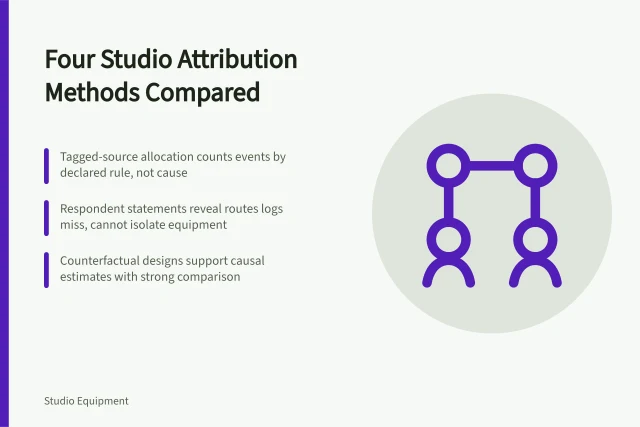
- Treat attribution as an allocation rule, not proof that equipment caused an audience outcome.
Start with the decision, not the available feed
Name the decision that reporting must support. It might be whether to pause an unreliable capture configuration, revise a quality check, investigate repeated corrections or commission a proportionate evaluation. Give that decision an owner, required evidence, review date and stop condition.
Then define the workflow boundary: England premises included, job types, equipment configurations, output formats, reporting period and timezone. A UK business table, global platform total or supplier case study cannot silently stand in for this population.
The GOV.UK Service Manual advises teams to understand the question before deciding what data is needed in its performance-data introduction. It was written for government services, so use the discipline rather than treating it as a private studio standard.
Keep five evidence classes apart
Production output is a completed operational event, such as a captured session or a release candidate reviewed. An observed outcome is recorded later under a stated collection rule.
Attribution assigns an observed event to one or more sources. Contribution analysis tests whether an intervention plausibly formed part of the explanation. Causal impact estimates the gap between what happened and a credible account of what would otherwise have happened.
Do not merge these labels. They answer different questions and permit different language. HM Treasury's current Magenta Book distinguishes process, impact and value-for-money evaluation, with experimental, quasi-experimental and theory-based approaches used for suitable impact questions. It is UK central-government method guidance, not evidence about creator equipment.
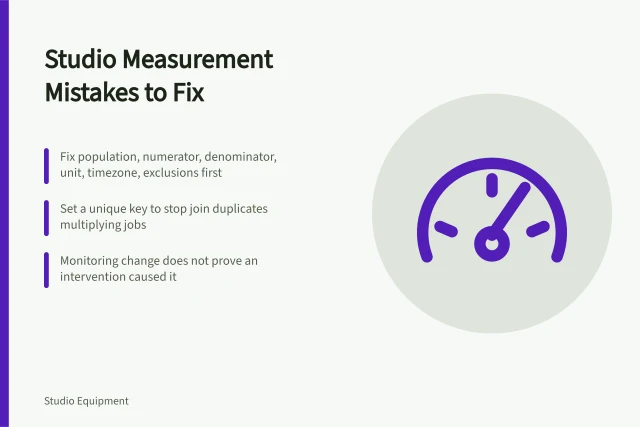
The accompanying QPIE guidance makes the boundary sharper: monitoring can identify a change, but does not show that an intervention caused it. A comparison or control group, assignment process, assumptions, missing data and alternative explanations matter when causal language is proposed.
Give every metric a contract
A metric name is too little. Record all of these fields:
- decision question and intended user;
- event and eligible population;
- England geography rule, period and timezone;
- numerator, denominator, unit and calculation;
- inclusions, exclusions and treatment of missing records;
- source systems, field names and collection route;
- join keys, query or worksheet version and dependencies;
- quality checks, uncertainty and known bias;
- evidence owner, decision owner and qualified reviewer;
- threshold-setting method, action and update trigger.
The Government Data Quality Framework identifies completeness, uniqueness, consistency, timeliness, validity and accuracy as distinct concerns. A dataset can be complete yet duplicated, current yet inaccurate, or correctly formatted while representing the wrong population.
Keep the raw count beside every rate. If an eligible record is missing, do not remove it merely to protect the percentage. Explain how late arrivals, cancellations, retries, corrections and withdrawn work are treated.
Measure studio production without rewarding shortcuts
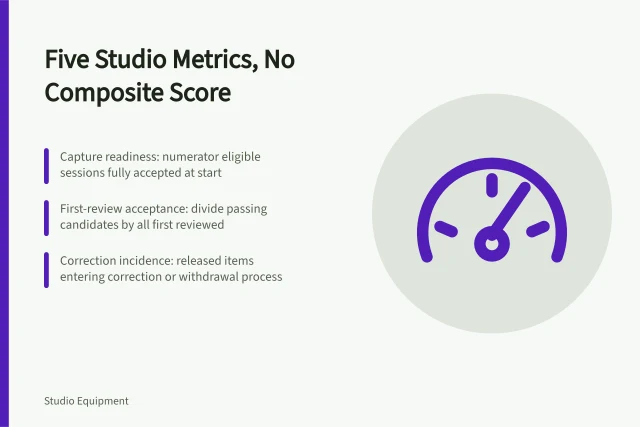
Useful production questions concern readiness and controlled delivery. Did a planned session reach its approved start state? Did a release candidate pass its first documented review? Was the published package reconciled across media, captions, transcript, disclosure and rights evidence? Could an authorised sample be restored to the nominated fallback?
Each needs its own denominator. Capture readiness should include eligible held sessions, because missing evidence is part of the result. First-review acceptance should count the first decision on a candidate, not repeated attempts until it passes. Correction incidence needs a fixed observation window. Restore acceptance describes the selected exercise, backup version and conditions only.
Never use an unsourced England target. Establish a local baseline after the process and collection method are stable, then choose a threshold from risk, capacity and decision cost. A team should not gain credit for changing eligibility after seeing the outcome.
Equipment records also need discipline. Use the exact asset and configuration identifiers that the operating workflow controls. A family name can conceal different firmware, connection routes or settings. Measurement does not prove safety, product conformity or fitness for work; those remain separate specialist decisions.
Record quality and accessibility as defined events
Avoid a single quality score. A score can hide a failed non-compensating gate behind stronger results elsewhere. Store the actual acceptance decisions for technical file specification, caption and transcript parity, essential visual alternatives, cleared rights, privacy, disclosure and archive integrity.
The government's accessible communication formats guidance discusses planning, audience needs, captions and approved source text in public communications. It can inform an evidence checklist, but it does not certify a private creator output. A named accessibility specialist must set the actual requirement and examine the delivered journey.
For each gate, record pass, fail, unresolved or not applicable. Not applicable needs a reason and owner. A late edit should reopen affected checks rather than inherit the previous decision.
Build reporting that another reviewer can reproduce
Preserve the input snapshot or immutable reference, calculation logic, dependency versions, manual decisions, exceptions and final reporting output. The Government Analysis Function's RAP strategy recommends coded workflows alongside version and dependency controls. These methods improve auditability, but automation cannot make a poor definition sound.
A practical dashboard has four views. Operations shows eligible work and current states. Equipment shows asset identity, approved configuration and exceptions. Releases reconcile all components to one candidate. Decisions show who acted, on what evidence and when the action will be checked.
Display missing rows, unmatched joins and late data. Do not bury them in a footnote while presenting the headline as settled. The Government Analysis Function's guidance on communicating quality, uncertainty and change asks producers to make limitations useful for decisions; the page itself is under review, which belongs in publication-day verification.
Treat attribution as an allocation rule
A controlled destination code can associate a recorded event with a release. A source question can capture what a respondent remembers. Each has coverage and bias. Cross-device behaviour, blocked technologies, missing permission, recall and question order can change the observed distribution.
Where cookies, pixels, scripts, link decoration or similar technologies are proposed, the ICO's storage and access guidance requires a separate UK privacy and PECR assessment. Analytical convenience does not remove that gate.
Publish the attribution window, eligible events, duplicate rule and handling of unknown sources. Call the output allocated or attributed, not incremental. If several rules are shown, do not average them. They represent alternative allocations of the same observations.
Use contribution and causal evaluation carefully
Contribution analysis begins with a proposed chain: an equipment or process change affects capture reliability, may affect accepted output and a later defined event. Test whether the expected steps occurred, seek contrary evidence and examine rival explanations.
HM Treasury's Magenta Book analytical annex describes contribution analysis as a structured way to strengthen an evidenced line of reasoning, not definitive proof.
A causal question needs a plausible counterfactual. Pre-specify intervention, eligible units, outcome, assignment, comparison, period and analysis. Consider spillovers, implementation changes, missingness and whether the sample can answer the question. Randomised or suitable quasi-experimental work may be appropriate; a simple before-and-after chart usually cannot isolate the equipment from seasonality, content, staffing or audience changes.
Use a qualified evaluator or statistician. Report uncertainty and all material deviations. A null or inconclusive result is not a failed report, and an observed improvement is not permission to promise performance.
Minimise personal and commercially sensitive data
Most workflow reporting can use job, asset and release identifiers. Do not collect contributor names, account histories or device-level audience data unless the declared purpose actually needs them. The ICO's data-minimisation guidance describes a three-part boundary: personal data must be sufficient for the purpose, rationally connected to it and no more extensive than needed.
Map access by role, retention and deletion. Protect raw rows and audit logs. NCSC guidance on logging for security purposes recommends designing logs around questions an incident investigation must answer. It also notes that outsourced services can make access difficult, so confirm retrieval and export before relying on a supplier.
Small groups may expose people even without names. Suppress or aggregate where needed and keep worker monitoring, audience tracking and commercial analysis under separate qualified review.
Refuse weak benchmarks
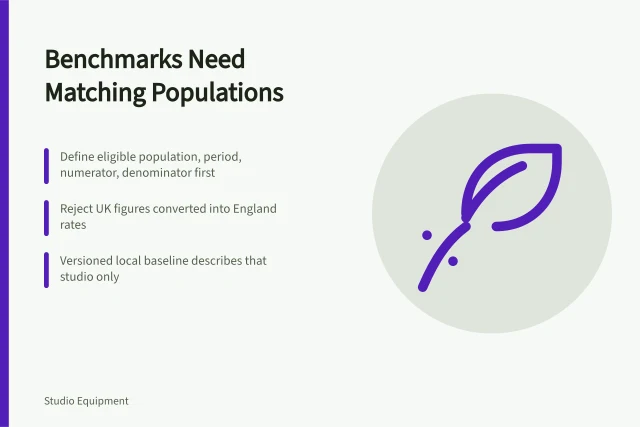
Before accepting an external average, compare population, geography, workflow, equipment scope, period, event, numerator, denominator, collection, missing-data treatment and uncertainty. The ONS quality in official statistics material covers relevance, accuracy and reliability, timeliness, accessibility, and coherence and comparability. Those concepts are useful appraisal questions even though a studio report is not an official statistic.
The ONS UK business dataset contains enterprises and local units by stated classifications and geographies. It does not isolate creator studios or provide a denominator for capture quality, corrections or equipment contribution. Do not turn a broad business count into a niche performance norm.
If no candidate matches, say so and build a versioned internal reference series. Describe the specific studio and period. Do not label it an England average.
Keep public claims behind their own gate
Internal evidence can support an operational decision without supporting an advertisement. If a public statement says a setup is faster, clearer, more reliable or commercially effective, retain the exact population, method, result, uncertainty and comparison with the claim file.
CAP's substantiation guidance says marketers should hold documentary evidence before publishing objective claims capable of substantiation. Qualified advertising review is still required. A dashboard, testimonial or supplier statement does not automatically prove the proposed wording.
Run a reporting cycle that can stop
Freeze the period and input versions, run quality tests, review exceptions, calculate from the approved definitions and have a second competent person reproduce material results. Publish the evidence labels and uncertainty. The decision owner then records an action, a deadline and the condition that would reverse it.
Pause a series when the workflow, definition, collection route, asset population or source changes. Correct prior reports visibly if an error affects decisions. Retire a metric when it no longer serves its question or creates more collection risk than decision value.
Good reporting leaves a trail from question to action. It may justify maintenance, investigation, a controlled test or no change. It cannot turn studio activity into an England benchmark, an equipment endorsement or a guaranteed result.
Before you act
- Name the decision, owner, evidence, review date and stop condition.
- Define the workflow boundary, period and timezone before collecting data.
- Write a full metric contract for each measure.
- Keep raw counts beside every rate.
- Record each quality and accessibility gate separately.
- Publish attribution windows, duplicate rules and unknown sources.
Common questions
Why should production counts and audience outcomes be kept apart?
A clean recording count does not prove audience benefit, and a tracked enquiry does not show that a camera or microphone caused it. The article says these are separate tasks with different questions and permitted language, so merging them would overstate what the evidence supports.
What should a metric contract contain?
It should record the decision question and intended user, event and eligible population, geography rule, period and timezone, numerator, denominator, unit and calculation, inclusions and exclusions, source systems and join keys, quality checks, owners, thresholds and update triggers.
How should attribution results be described?
Publish the attribution window, eligible events, duplicate rule and handling of unknown sources. Call the output allocated or attributed, not incremental. If several rules are shown, do not average them, because they represent alternative allocations of the same observations.
In this guide
- Five studio metrics from capture readiness to restore testDefine England studio metrics for readiness, accepted outputs, corrections, accessible packages and restore tests without inventing benchmarks.
- A controlled studio dashboard with versioned queries and visible gapsBuild a controlled studio dashboard with fixed definitions, versioned queries, visible missing data, evidence links and cautious interpretation.
- Four ways to attribute studio outcomes, and how strong each conclusion isCompare four studio attribution methods on one outcome unit, evidence need, bias, privacy burden and the strength of conclusion each permits.
- Studio measurement mistakes, from starting with the available count to losing duplicatesSeven non-ranked studio measurement mistakes, each tied to an official method record and a practical corrective action for England operations.
- Studio benchmarks are worth using only when the population matchesResearch studio benchmarks through exact populations, periods, denominators and uncertainty, and record when no defensible comparison exists.