Tools and providers
Part of Choosing studio tools and suppliers on a common evidence grid
Implementing a studio tool with authorised test assets and a way back
Implement a studio tool with authorised test assets, versioned configuration, separate safety and rights gates, rollback and restart evidence.
Implement one exact model or software release in an isolated, reversible trial. Preserve the existing workflow until the new route passes its acceptance tests and mandatory specialist gates. This guide specifies the method; it does not report a real installation or result.
What to take away
- Preserve the existing workflow until the new route passes acceptance tests and mandatory specialist gates.
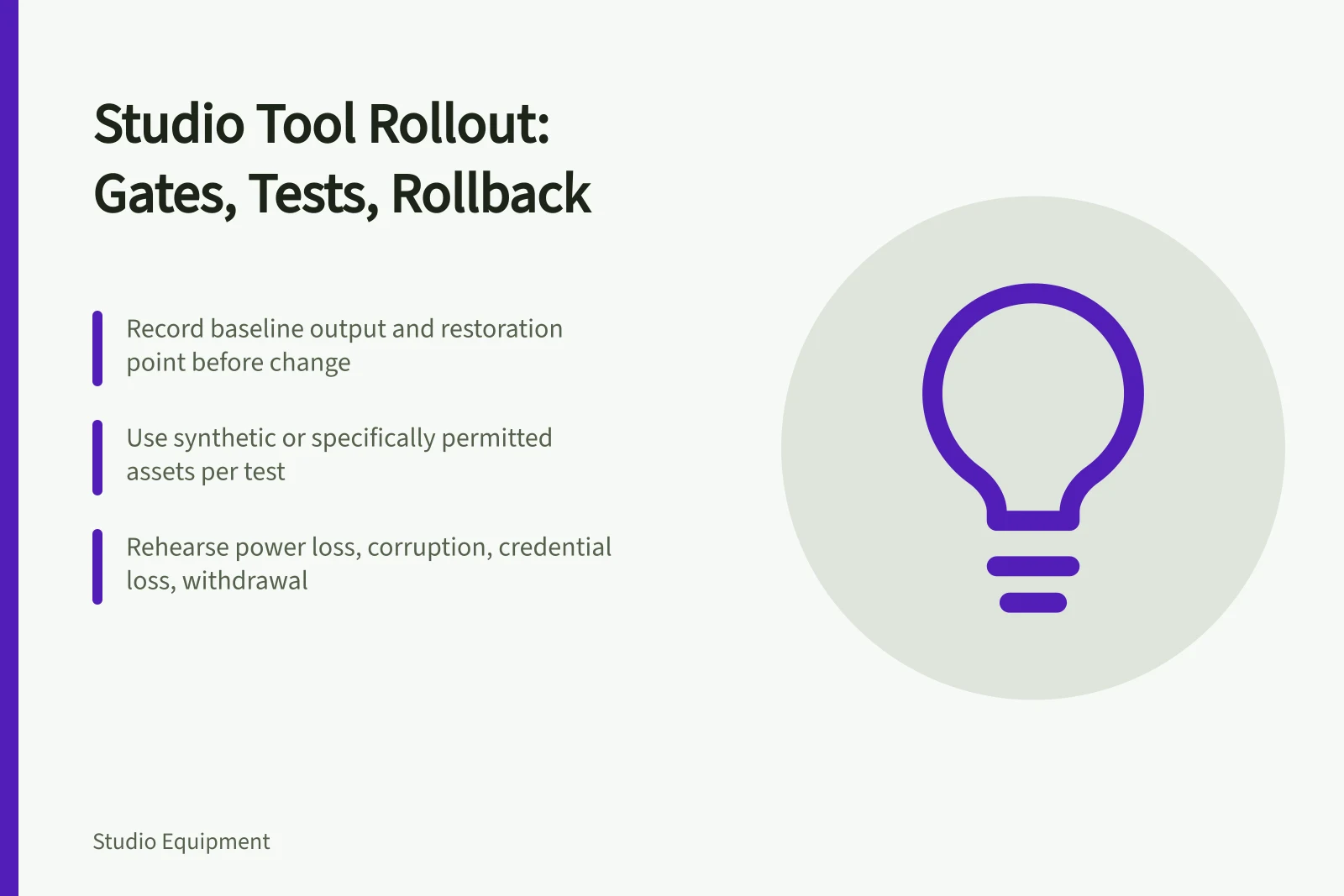
- Record the baseline output and restoration point before making any change to the system.
- Use synthetic material or assets with specific permission, keeping media and client permissions per test asset.
- A successful launch screen or sample export is not evidence that every required task works.
- Approve a limited production scope only if every mandatory gate passes and the fallback has been restored.
Freeze the approved change
Name the owner, purpose, product or release, supplier, installer source, hardware, operating system, firmware, plug-ins, licences and connected services. Capture hashes or signed-package evidence where available. Record the baseline output and restoration point before any change.
Use synthetic material or assets with specific permission. The IPO's digital-images copyright guidance does not itself grant a right to use a picture. Keep media, appearance, music, software and client permissions against each test asset.
Prepare safety and access routes
For equipment used at work in England, a competent person should assess the real installation, power, mounts, cables, operators and maintenance. HSE's PUWER overview addresses suitability, inspection, information and training in Great Britain. Product-supply evidence remains a separate OPSS and legal review.
Write accessibility tasks for setup, core controls, help, warnings, correction and exported media. Test them with intended users or suitable representatives and preserve barriers, workarounds and severity. Do not accept a general accessibility statement as evidence for the exact configured journey.
Limit access and data
Create named accounts with the least privilege needed. Disable unused remote access, rotate default credentials, isolate the trial where proportionate and document update responsibility. The NCSC small-organisation cyber guide supports basic device, account and backup controls, but does not approve a product.
Map personal information before uploading or recording it. ICO data-protection-by-design guidance places early design responsibility on the controller. Record purpose, role, fields, access, sub-processors, transfers, retention, deletion and incident response for the trial and proposed production state.
Run defined production and failure tests
Use the same approved input for the baseline and new route. Check capture or import, edit, review, accessible output, metadata, export and restore against prewritten acceptance criteria. Log version, settings, operator, time window and deviations. A successful launch screen or sample export is not evidence that every required task works.
Rehearse interrupted power or network, damaged input, lost credential, supplier outage, corrupted project, disclosure correction and urgent withdrawal where relevant. For commercial output, section 3 of the CAP Code keeps objective claims tied to evidence; a tool cannot make an unsupported product statement acceptable.
Run a support rehearsal without exposing live credentials or client material. Record the route used, information requested, authority granted and how access was removed. Check whether the response depends on an unapproved account, remote-control utility or transfer. An advertised support channel is not evidence that the required incident can be resolved within a chosen time.
Decide, roll back or restart
The change owner gathers safety, accessibility, privacy, security and rights decisions without averaging them. They gather procurement, contract and finance decisions likewise.
Approve limited production scope only if every mandatory gate passes and fallback restored successfully.
Otherwise revoke trial access, export required records, remove credentials, obtain deletion evidence and return to the preserved baseline; document failure and conditions for new trial, and do not quietly change acceptance rule.
For an approved restart, state the first permitted production, operator, monitoring period and stop trigger. Keep the old route available until that window closes. A later edition, firmware update, new plug-in, changed mount or added cloud function reopens only the affected tests and review gates.
Before you act
- Name the owner, purpose, product, supplier, installer source and hardware.
- Record the baseline output and restoration point before any change.
- Keep permissions against each test asset used in the trial.
- Create named accounts with the least privilege needed.
- Map personal information before uploading or recording it.
- Rehearse failure scenarios such as interrupted power or lost credentials.
Common questions
What should be recorded before any change is made?
Name the owner, purpose, product or release, supplier, installer source, hardware, operating system, firmware, plug-ins, licences and connected services. Capture hashes or signed-package evidence where available. Record the baseline output and restoration point before any change.
How should accessibility be tested for the trial?
Write accessibility tasks for setup, core controls, help, warnings, correction and exported media. Test them with intended users or suitable representatives and preserve barriers, workarounds and severity. Do not accept a general accessibility statement as evidence for the exact configured journey.
What happens if the mandatory gates do not pass?
Revoke trial access, export required records, remove credentials, obtain deletion evidence and return to the preserved baseline. Document the failure and conditions for a new trial rather than quietly changing the acceptance rule. Approve a limited production scope only if every mandatory gate passes and the fallback has been restored successfully.