Tools and providers
Part of Choosing studio tools and suppliers on a common evidence grid
Selecting studio software by testing the whole dependency chain
Select studio software through exact workflow tests covering versions, access, security, privacy, rights, exports, switching and total commitment.
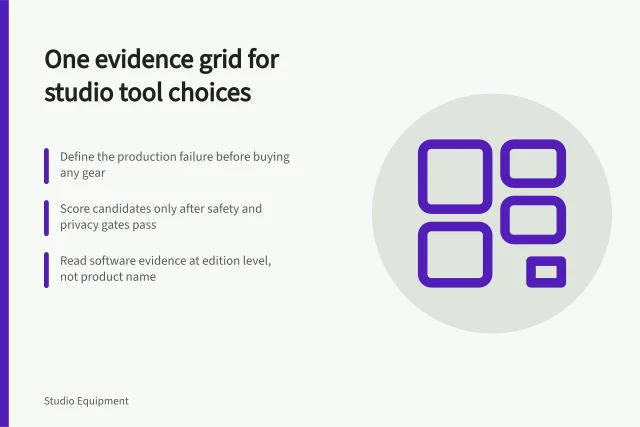
Select software against one production route, not a feature total. Define the approved input, operator, edit task, accessible output, review path, destination and recoverable archive. Keep the current application or manual process as the baseline.
No product was installed for this desk guide. Supplier documentation can establish what a developer states, but only an authorised local trial can show whether the actual computer, assistive technology, plug-ins and files work together.
What to take away
- Test a candidate against one production route rather than comparing feature totals across products.
- A supported operating system is only the start of testing, not proof of recording or streaming performance.
- Map cloud and account features before uploading footage, because a desktop download may not be local.
- Approve only after the candidate and baseline receive the same authorised files and acceptance tests.
- Preserve the installer and configuration needed to recover work, subject to licence and security review.
Make the need testable
Replace faster editing with an observable task. Record the source format, target export, maximum acceptable loss, review owner and pass evidence. Add non-negotiable needs such as keyboard access, captions, offline operation, specific project interchange or a restorable master. State which capabilities are optional.
Make the need testable
- Record source format and target export
- Set maximum acceptable loss
- Name review owner and pass evidence
- Add non-negotiable needs
- State which capabilities are optional
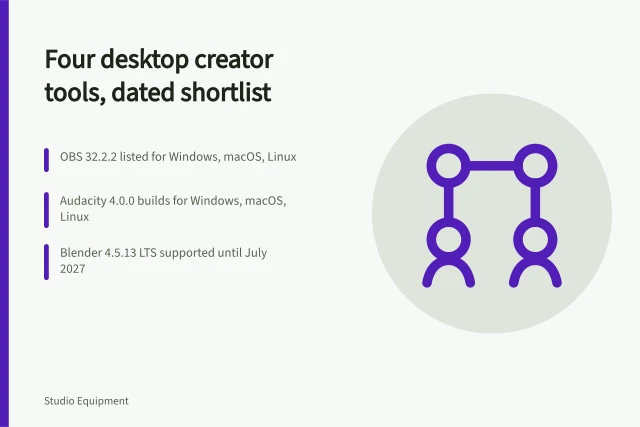
Check the exact release. The OBS system-requirements page says basic compatibility does not guarantee recording or streaming performance because encoding, resolution, frame rate and scene complexity matter. This is a useful warning for every candidate: a supported operating system is the start of testing, not a result.
Inspect the whole dependency chain
List the application edition, installer source, licence, operating system, drivers, codecs, plug-ins, hardware, accounts, network services and export formats. Record the supplier page date and the person who verified it. Reject a candidate if its essential edition or distribution route cannot be identified.
For cloud or account features, map the data before uploading footage. The ICO's data-protection-by-design guidance says controllers should address privacy from the start. Identify purposes, roles, fields, access, sub-processors, transfers, retention, deletion and incident support. Do not assume a desktop download is entirely local.
Test access and rights as core functions
Create task-based accessibility checks for installation, opening a project, navigating essential controls, editing, error recovery, help and export. Government inclusive-communication guidance is aimed at government communicators, but its supplier and format planning can inform a brief. A named specialist must set the real requirement and test with intended users or suitable representatives.
Check what the licence permits for team members, devices, client work, generated outputs, templates and termination. The IPO's digital-images copyright notice does not grant permission to use an asset. Keep source rights and software terms in separate evidence rows.
Examine security and exit before adoption
The NCSC's small-organisation cyber guide covers backups, devices, online accounts and attack recognition. Translate the relevant controls into the trial: verify the distribution route, use least privilege, protect accounts, isolate untrusted plug-ins and restore an exported project.
Price the exact term, users, storage, support, training, migration and exit through a dated quotation. Do not treat a headline charge as total cost. Set a ceiling and owner for any paid expansion.
Add an update rule before approval. Name who reads release and security notices, which project version stays supported, when plug-ins are retested and what change forces a rollback.
A new major release should enter the grid as a new candidate, not silently replace the build that passed. Preserve the installer and configuration to recover work, subject to licence and security review.
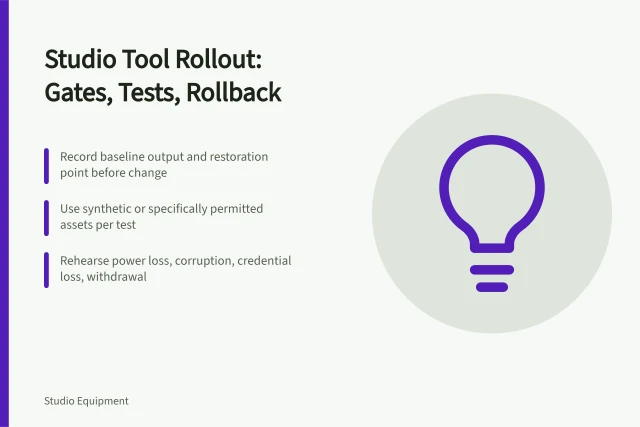
Approve only after the candidate and baseline receive the same authorised files and acceptance tests. Preserve settings, logs, output checks, accessibility findings and failures. Rehearse rollback, account closure, credential removal and deletion. Hold the decision where a required format, right, security control, privacy term or usable export remains unresolved.
The final record should name the selected edition, accepted scope, excluded tasks, evidence owners, review dates and restart authority. It should also explain why the baseline was rejected or retained. That makes a later renewal or migration decision possible without inventing a performance history.
Before you act
- Define the approved input, operator, edit task and accessible output.
- Record the source format, target export and maximum acceptable loss.
- List the application edition, installer source, licence and drivers.
- Create task-based accessibility checks for installation, editing, help and export.
- Price the exact term, users, storage, support and exit.
- Name who reads release and security notices before approval.
Common questions
Why is a supported operating system not enough to approve editing software?
The OBS system-requirements page says basic compatibility does not guarantee recording or streaming performance, because encoding, resolution, frame rate and scene complexity matter. A supported operating system is the start of testing, not a result, so the actual computer, assistive technology, plug-ins and files must be trialled together.
What should be mapped before uploading footage to cloud or account features?
Identify purposes, roles, fields, access, sub-processors, transfers, retention, deletion and incident support. The ICO's data-protection-by-design guidance says controllers should address privacy from the start. Do not assume a desktop download is entirely local, so map the data before any footage is uploaded.
What must happen before a candidate is approved?
The candidate and baseline must receive the same authorised files and acceptance tests. Preserve settings, logs, output checks, accessibility findings and failures. Rehearse rollback, account closure, credential removal and deletion. Hold the decision where a required format, right, security control, privacy term or usable export remains unresolved.