Outlook
Part of Studio equipment decisions for 2027 with accessibility moved to the beginning
Where AI fits in a studio workflow once the manual route is on record
Assess bounded AI tasks in a studio workflow through supplier evidence, manual baselines, human ownership, data, rights, security and access gates.
AI is not one equipment category. In a studio it may sit inside transcription, search, audio correction, masking or generative editing software attached to an existing capture chain. Approve a task, input population and accountable human decision, not an undefined AI strategy.
What to take away
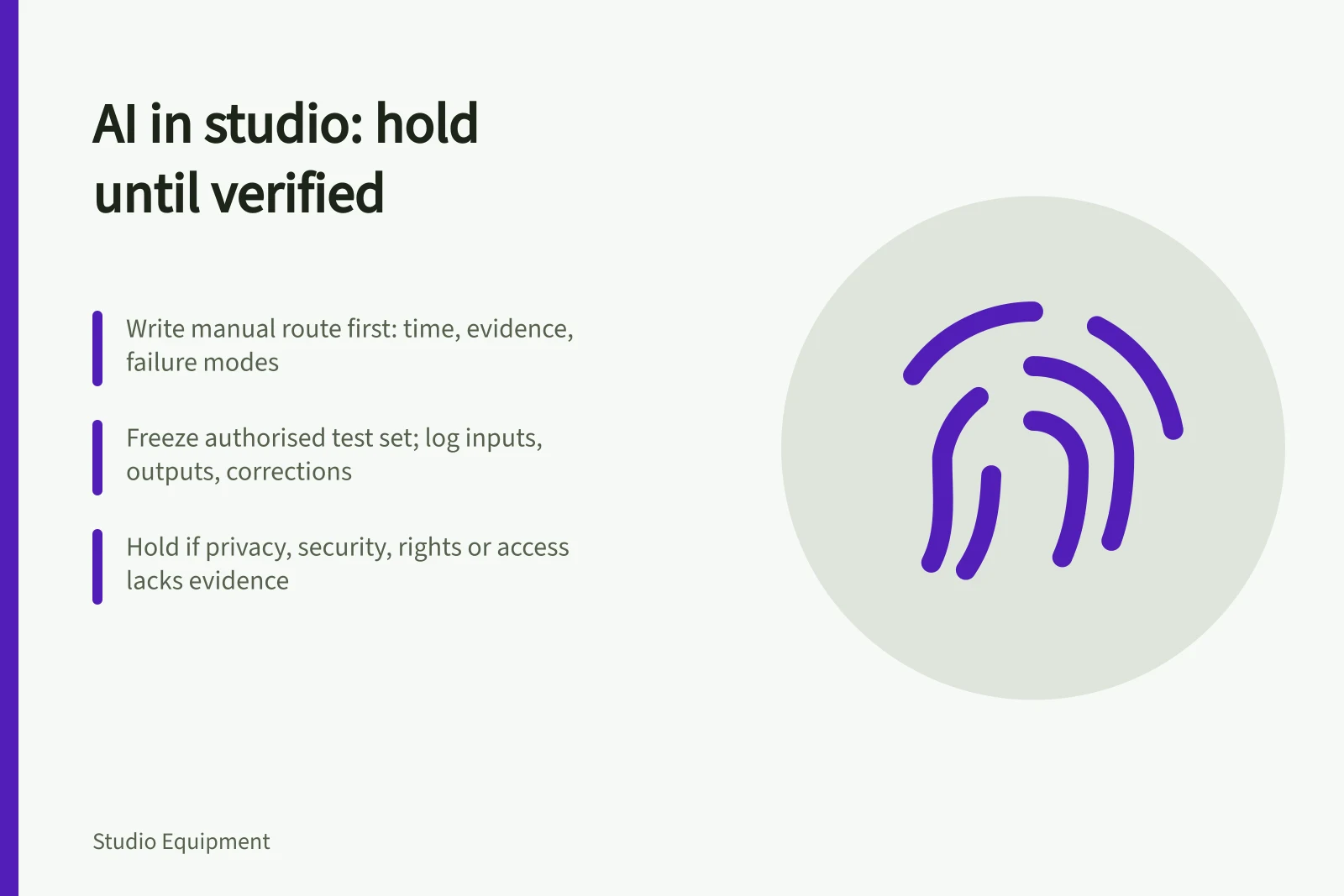
- Write down the manual route first, including time, evidence, failure modes and acceptance, and keep it as the fallback.
- Supplier claims about AI functions are not independently tested accuracy and need contract and technical verification.
- Build a frozen test set from authorised material and compare it against the manual route using the same acceptance checks.
- Keep the verdict at hold if privacy, security, rights or accessibility lacks evidence, and reassess when anything changes.
Begin with the manual route
Write down how the task is completed without the proposed function; for captions, use a human-produced draft then editorial and accessibility checks, and for media search, use logged filenames and human tags.
Manual Baseline Record
- Write down task without proposed function
- Captionshuman draft, editorial, accessibility checks
- Media searchlogged filenames and human tags
- Record time, evidence, failure modes, acceptance
- No invented saving; manual route is fallback
- Rehearse restore and export before switching
Record time, required evidence, failure modes and output acceptance without inventing a saving. The manual route remains the fallback until restore and export have been rehearsed.
Current supplier statements
Adobe's UK Premiere AI feature page describes speech-to-text, media search, audio categorisation, masking and generative extension. These are global supplier claims about documented functions, not independently tested accuracy or England adoption.
Supplier Claims vs Verification
Supplier page
- Functions
- Speech-to-text, search, masking
- Generative Extend
- Internet required, media limits
- Data use
- Adobe position stated
What it settles
- Functions
- Documented features
- Generative Extend
- Technical constraints
- Data use
- Contract starting point
What it does not settle
- Functions
- Tested accuracy or adoption
- Generative Extend
- UK privacy, confidentiality, copyright
- Data use
- Exact plan verification
Its Generative Extend record, updated 21 January 2026, says the function requires an internet connection and publishes media and workflow limits. The page also describes Adobe's data-use position. Those statements require contract and technical verification for the exact plan; they do not settle UK privacy, confidentiality or copyright questions.
A task card for each proposed use
For transcription, name eligible speakers and languages, human corrector, caption standard, error categories and the condition that forces manual production. Do not publish an unreviewed transcript or infer speaker identity from a label.
For media search or classification, list the indexed folders, metadata produced, false-match review and material excluded because it is confidential or lacks permission. The human editor decides whether a returned clip belongs in the project.
For generative extension or synthetic media, preserve the original, prompt, model and software version, generated segment, rights evidence, review history and withdrawal route. Generated material must not be presented as captured reality. Objective advertising claims still need prior evidence under CAP's current substantiation guidance.
Evaluate without manufacturing a success story
Build a test set from synthetic or specifically authorised material that reflects the defined task. Freeze it before running the feature. Log every input, setting, output, human correction, rejected result and processing failure. Compare against the manual route using the same acceptance checks, not a supplier demonstration. Report missing cases and assessor disagreement as well as completions.
Do not publish a time-saving percentage from an informal trial. The decision may simply be that the feature can proceed to a larger controlled assessment, must remain restricted to low-risk drafts, or should be withdrawn. A change in version or model invalidates conclusions that depend on it.
Four independent gates
Privacy: map uploads, prompts, recordings, logs, accounts, retention, deletion, processors and transfers. The ICO's AI and data-protection toolkit is practical support, but is currently marked under review following the Data (Use and Access) Act. A qualified reviewer must apply the live position.
Security: threat-model the input, model, plug-ins, export and supplier access. NCSC's secure AI development guidance calls for documented assets and supply-chain controls. It is not a certification of a chosen tool.
Rights: establish permission for source media, training-related representations, generated output, likeness and downstream reuse. The UK government's copyright and AI consultation record was updated in March 2026 and describes unresolved policy questions; it is not a new licence.
Accessibility: test the delivered caption, transcript, audio, control path and correction process with intended users. Automation does not make an output accessible by itself.
Keep the verdict at hold if any gate lacks evidence. Reassess when the model, plan, terms, data route, guidance, task or audience changes.
Before you act
- Document how the task is done without the proposed function.
- Define eligible speakers, languages, corrector and caption standard for transcription.
- List indexed folders, metadata, false-match review and excluded material for search.
- Preserve original, prompt, model version, rights evidence and withdrawal route for generated media.
- Log every input, setting, output, correction and failure against the manual route.
- Map uploads, prompts, logs, retention, deletion, processors and transfers for privacy.
Common questions
What should a task card for transcription specify?
It should name eligible speakers and languages, the human corrector, the caption standard, error categories and the condition that forces manual production. An unreviewed transcript should not be published, and speaker identity should not be inferred from a label.
Why is a time-saving percentage from an informal trial unreliable?
The article says not to publish a time-saving percentage from an informal trial. The decision may be to proceed to a larger controlled assessment, restrict the feature to low-risk drafts, or withdraw it. A change in version or model invalidates conclusions that depend on it.
What happens if one of the four gates lacks evidence?
Keep the verdict at hold if any gate lacks evidence. Reassess when the model, plan, terms, data route, guidance, task or audience changes. The four gates are privacy, security, rights and accessibility, and each needs its own evidence.